Reading Leah Price’s LRB review of William Sherman’s Used Books: Marking Readers in Renaissance England, I hit this sentence: “Sherman puts the digits back in the digital age, arguing that its verbal and visual metaphors derive from the long tradition of hands that mark books and the manicules marked in them.” Manicules? It wasn’t in the dictionaries, even in the OED (where the letter M was recently revised), so I googled, and discovered this enlightening essay by the very same William Sherman, in which he explains that “the textual hand-with-pointing-finger symbol” has (very oddly) never had an agreed-on name: the book trade has variously used “fist,” “hand,” “index cut,” “director”…
I have now found 15 other names for what I prefer to follow the manuscript specialists in calling the manicule: hand, pointing hand, hand director, pointer, digit, fist, mutton fist, bishop’s fist, index, indicationum, indicator, indicule, maniple, and pilcrow. The last three terms are outright mistakes: indicule and maniple are mishearings, misrememberings, or conflations of similar words. … Pilcrow, finally, properly designates the backwards p symbol used to mark new paragraphs (¶—many of us still use the symbol in editing texts but, again, few of us could recognize or recall the technical term for it). But the rest of the names have all been ‘correct’ at some point in the history of texts, and most of them can still be found in recent literature. The only way a single name could be established is if librarians can agree upon a standardized terminology for marks like this one and then achieve universal dissemination among their staff and readers…
For my part, I have settled on “manicule” because it seems like the most general and most neutral description of the symbol: it derives from the Latin manicula, simply meaning “little hand,” and that really captures what it is without getting into the messy business of what it does. Another thing that “manicule” has going for it is that it applies equally to little hands in all kinds of texts, and to those produced by readers as well as for them, whereas “fist” has its origins in printers’ slang and should properly be restricted to the products of the printing press. The biggest problem with “manicule”—aside from the fact that people will keep mixing it up with manciples, manacles, and manicures—is that it is not (yet) an English word. It is apparently the standard term for the symbol in modern romance languages and it is belatedly being imported into English, but it’s not yet in the OED or any other dictionary of current usage, and my spell-checker certainly doesn’t like it.
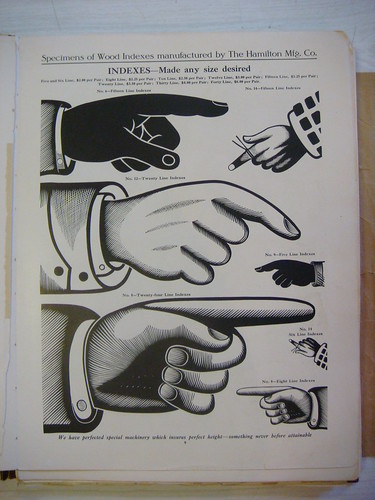
I agree with him that it would be very useful to have a single, unambiguous term for the thing (you can see a few samples here), and I hereby urge everyone to start calling it “manicule” and lobby the OED to include it. (Aside from terminological issues, by the way, Sherman’s essay is very interesting on the symbol’s history and uses.)
Update. Here‘s a nice set of images—thanks, Nathan!
What? Am I hearing Hat urge the imposition of a usage by fiat? Lay me down, brothers, I have lived too long!
This would be an excellent name for the mouse pointer customarily used to indicate a hyperlink in web browsers. It is commonly referred to by several different terms but “manicule” fits perfectly.
I will never forget the name of the symbol ¶, because i’ve got a rather large one tattooed on my forearm. And as arbitrarily selected terms of art go, ‘manicule’ is good. But Hat, my hatred of standards and monoculture will impel me to use ‘manicule’ only in equal proportion with the equally delightful ‘indicule’, ‘indicationem’, and above all, ‘mutton fist’.
I tell my students it’s a “cursor” and I have them memorize the word along with nine other words like “click” and “mouse” (which they insist on calling a ratón). If you name the pointy finger thingy, then don’t you have to name the hourglass wait thingy and the arrow at an angle thingy and the open hand that curls its fingers to pull the page thingy too?
Can’t we have a slightly more naturalised version, something like ‘mancle’? I can’t imagine it would be confused with ‘manacle’, from a roughly similar derivation.
Am I hearing Hat urge the imposition of a usage by fiat?
Moi, impose by fiat? Never! Suggesting and encouraging is not imposing, and I shouldn’t really have said “everyone” anyway. My ideal situation would be for we hoi polloi (take that, purists!) to use our own favorite terms (like Z.D. Smith, I’m very partial to “mutton fist”) but be aware of a standard term used by those in the trade, and it seems “manicule” is the obvious candidate for that.
Now I understand how power corrupts: if I could impose “mutton fist,” I would.
This seems as good a place as any to say that am SHOCKED at the tiny writing in the NYRB edition of CV Wedgwood’s The Thirty Years War, that I received today. Shocked. They must think it’s being read by ants.
That’s funny, they make it look reasonable in the preview.
You might try sending a suggestion to the Unicode folks… IIRC, they’ve got several manicules in various symbol sets.
I love the kind with a very curly index finger and thumb facing towards you, that looks like one of those saints’ hands pointing heavenwards in a Renaissance painting.
they make it look reasonable in the preview
It does, doesn’t it? The actual book is quite small, though. Whereas on my screen it’s about a foot high. Shocking.
Enjoyable post (and comments). Is there a term for the symbol ‘@’, other than “at sign” (which strikes me as equivalent to “doohickey”)? I thought I once stumbled across a term in French, but of course it’s awfully difficult to re-look something like that up….
it’s awfully difficult to re-look something like that up
Wikipédia.
Linguist List discussion (from 1996).
BTW, do you know there’s an annoying Ads by Google bar obscuring part of your post?
Count me among the backers of “mutton fist”.
I don’t think a separate word for “hourglass” needs to exist, because we have, well, “hourglass”. Likewise “crosshairs” and other cursor forms. But finger pointer thingy? No. Henceforth it shall be a manicule.
What was that word again–cuticle, madrigal, ….oh, I know what this thing is. It’s the Flying Fickle Finger of Fate.
Is there a term for the symbol ‘@’ … ? I thought I once stumbled across a term in French …
The French word for this symbol is arobase. Don’t ask me why.
annoying Ads by Google bar
He nose. You just have to refresh and it moves, apparently. It’s 5.30 am and my dog got out.
” Is there a term for the symbol ‘@’, other than “at sign”?”
The Wikipédia entry says it all, really. I particularly like the Dutch “apenstaartje” (small tail of a monkey).
I still don’t understand why the French word ends in e.
Well I don’t think anyone else here is going to be able to explain it. You’re our French expert. I know a few other French words that end in E, if that helps,
Thank you, AJP. Thousands of French words end in e, but there seems to be no linguistic reason why this one should. Other words ending in -ase (= English -asis) come from Greek, but (according to Wiki) this one comes from a Spanish word (arroba) in its plural form (arrobas), a word which moreover has a French equivalent (arrobe), also with singular and plural forms. I suspect at least one misunderstanding somewhere in the evolution of the name for the little squiggly.
If “mutton fist” is a printer’s term, I suggest it may properly only applies to “hand” characters that are a “mutton” wide, that is, as wide as the character “m”. The “m” character is used as a standard measurement in typesetting, and the measurement is/was known in printing shops as a “mutton”, while the width of the “n” character was referred to as a “nut” (as in the typesetting instruction “set single column, nut each side”, meaning “leave a space equal to the width of the character ‘n’ either side of the column of type”). They were named “mutton” and “nut” because “em” and “en” sound too similar and would be easily confused.
Oh dear. For years I’ve been using the term “fistnote” for this symbol (using possibly only within my head, may be the saving grace), but now I find that actually refers to the pointed-to text.
(The use of “fist” is peculiar. To me an unmodified “fist” has no possibility of having any fingers in any conformation other than… in a fist.)
“Maniple & Pilcrow” would be a good name nowadays for a twee, overpriced store selling something or another.
(Or rather, “maniple + pilcrow”.)
I won’t be surprised if the only reason many people recognize the ¶ symbol at all is because it shows up in Microsoft Word (and. apparently, some other similar editors) in place of the carriage return, i.e. at the ends of paragraphs, under the “include hidden characters” setting (or whatever it’s actually called) – whose toolbar icon also happens to be this character.
Does it ever show up in anything else those days?
EDIT: apparently there’s a project called Purple Pilcrows promoting the use of the ¶ symbol in some particular kind of web links (a bit hazy on the details). Which is incidentally an awesome name for a band 🙂
It sure is!
*raises hand*
A purple pilcrow appears at the end (rather than the beginning) of a paragraph, and appears only when the mouse is near the paragraph; otherwise it is invisible or nearly so. It serves as a permalink to the particular paragraph.
The Zeitgeist seems to call for something more meta and ironic; ‘As the Pilcrow Flies’?
I believe I learned of the ¶ sign back in the 90s, when poking around to see what symbols are available on Apple’s keyboard layouts (it was, and continues to be, found as alt+§).
The OED entered manicule in June 2022, appropriately including one in the definition:
The OED uses the ☛ character occasionally in bibliographic references for signature marks; some early printers used characters such as this to distinguish front matter from the main text, according to this Folger Shakespeare Library blog. The comments there also note that in 2016, the Rare Books and Manuscripts Section of the American Library Association made manicule an official term, but only for hand-drawn marginalia, not the printed character.
The only place where the OED uses ☛ in its own text is under set:
At the Shady Characters blog, the most recent post about manicules is from 2022, Miscellany № 93: a fistful of manicules, about a specimen book just of manicules in different typefaces.
What a satisfying addition — thanks for alerting us!