In a comment to an earlier entry, Beth asked for an explanation of the image "black sun" in Mandelshtam. I replied that it was an apocalyptic image (see Isaiah, Mark, and Revelations) but had more specific and complex meanings for Mandelshtam. So let's look into how he uses it.
First, let's go all the way back to January 1837, when Russia's greatest poet, Aleksandr Sergeevich Pushkin, got himself killed in an idiotic duel over the virtue of his wife. A colleague of his named Andrei Kraevsky said in his famous obituary of Pushkin Солнце нашей поэзии закатилось! 'The sun of our poetry has set!' We now leap ahead to 1915 and the death of Scriabin, which prompted Mandelshtam to begin an essay, of which we have only fragments, called either "Pushkin and Scriabin" or "Scriabin and Christianity." The essay begins:
Pushkin and Scriabin are two transformations of a single sun, two interruptions of a single heart. Twice the death of an artist has gathered together the Russian people and kindled its sun above them. They gave an example of a sobornyi [joint, combined; synodal; of a spiritual collectivity], Russian demise; they died a full death, as people live a full life; their personality, dying, widened into a symbol of a whole people, and the sun-heart of the dying man remained forever at the zenith of suffering and glory.These images reoccur throughout Mandelshtam's collection Tristia. Phaedra is featured in the opening poem of this 1922 edition, "How heavy is the splendor of these veils and this attire amid my shame!" Particularly striking are the lines "And for the mother in love/The black sun will rise" and "I have stained the sun with black love," and the final quatrain...Tear away the covering of time from this creative life, and it will flow freely from its cause, death, settling itself around death as around its own sun and absorbing its light.
Pushkin was buried at night. They buried him secretly. Marble St. Isaac's—that magnificent sarcophagus—just didn't end up with the solar body of the poet. At night they laid the sun in the grave, and in the January frost the sledge runners squeaked along, carrying the poet's ashes away for the burial service.
I have recalled the picture of Pushkin's burial to arouse in your memory the image of a night Sun, the image of a late Greek tragedy by Euripides, the vision of unhappy Phaedra.
But we, bringing the deadSo the "buried sun" of the dead poet becomes the "night sun" and then the "black sun" of the passionate sinner Phaedra. In "This night is irretrievable" (page 24 of the linked edition) the black sun rises at the gates of Jerusalem, where "the Jews have buried my mother"; it ends "I awoke in a cradle, illuminated by a black sun." The association with funerals links this poem closely to the essay, but the sun seems to be playing a very different role, influenced by the Christian apocalyptic tradition.
With a funeral song into the house,
Will soothe the black sun
Of wild, sleepless passion.
Now we move ahead a few years to the terrible winter of 1920, of which Akhmatova said "All of the old Petersburg signs were still in place, but behind them, except for dust, darkness, and yawning emptiness, there was nothing. Typhoid, hunger, executions, darkness in the apartments, damp logs, people emaciated to unrecognizability.... All the cemeteries were destroyed. The city had not simply changed, but had completely turned into its opposite." (tr. Broyde) The two-year civil war was supposedly over—the major White armies had been defeated—and "according to official historiographers, the young republic of workers and peasants was now ready to turn all of its attention to socialist construction." (Brovkin, p. 300) And yet the peasant war, the war against the "Green army" of peasants fed up with endless expropriations and official violence, not only went on but spread to new provinces. The Bolsheviks had not expected it and refused to acknowledge it, but it required more and more "burned villages, mass deportations, and famine." Meanwhile the cities were freezing and starving. As Brovkin says (p. 270):
Life in a Soviet city of 1920 can be compared to the theater of the absurd. There were two worlds: one was the ideal and the other real... Newspapers reported on the heroic work of labor collectives and new victories on the external and internal fronts against the bourgeoisie and kulaks and wreckers and all the other enemies of Soviet power... In the real world factories were mostly idle, railroads barely functioned, tramlines stood still, and electricity was supplied only to party and government agencies. Water and sewage services did not function...
Mandelshtam's 1920 poems mostly seem to take place at night. In "Sisters, heaviness and tenderness," "Yesterday's sun is carried away on a black stretcher"; in "I want to serve you," "And in the midnight drama... I will call you"; in "A phantom scene barely glimmers," "And the night is pitch black"; in "The meaning of somber and barren Venetian life is clear to me," "Black Hesper glimmers in the mirror. Everything passes, the truth is dark," in the wonderful "I have forgotten the word that I wanted to say," "A night song is sung in forgetfulness," and in "Because I couldn't hold on to your arms" (bizarrely translated in the linked version as "If I am to know how to restrain your hands"), "I must wait for daybreak in the dense acropolis... Achaian men equip their steeds in darkness... The gloom has still not dispersed." But the central exhibit for us is the famous "In Petersburg we'll meet again As though we'd buried the sun there." Mandelshtam was revising the Scriabin essay at this time, and the image of burying "the solar body of the poet" ("At night they laid the sun in the grave...") is reproduced almost unchanged, except that Pushkin is no longer explicitly mentioned; instead, the sun seems to represent, as Broyde says (p. 92), Petersburg's cultural heritage as a whole. Here the night is "Soviet" (in the 1928 edition this was changed, for obvious reasons of censorship, to "January," which reinforces the connection with Pushkin's burial), and the second stanza describes the frightening circumstances of life in newly Soviet Petersburg—except that the narrator doesn't need a "night pass," because he will have the "blessed senseless word" ("senseless" implying non-utilitarian, the opposite of the "socialist realism" still to come). The whole complex of images is summed up in the last four lines:
Well, blow out our candles"You"—as opposed, that is, to the "we" who will meet in Petersburg, the immortal center of Russian culture; you can blow out our candles in your Soviet night, but there's a night sun that you'll never notice, the sun that shines the brighter for being buried. Or, as Bulgakov (another conflicted Soviet writer) put it in another "senseless word," manuscripts don't burn.
In the black velvet of worldwide emptiness,
The rounded shoulders of the blessed women still sing,
And you won't notice the night sun.
The Rosetta Project provides a large number of Swadesh lists online, allowing you to "create a custom word list chart." Via the suddenly reanimated Linguistiblogs, which also links to this delightful Proto-Indo-European crossword puzzle.
Diane Ravitch's new book, The Language Police, describes the disaster that has overtaken education with the triumph of know-nothing pressure groups on both left and right. Some results, from the summary in today's New York Times review:
¶Mickey Mouse and Stuart Little (because mice, along with rats, roaches, snakes and lice, are considered to be upsetting to children).Reality follows language usage. So is this Sapir-Whorf in action? Whatever it is, it won't keep kids from finding out what the world is like, but it will make it harder to talk about it. And people who haven't learned to confront reality in discourse will find it hard to deal with it in the world at large. But then, as T.S. Eliot so memorably said, human kind cannot bear very much reality.
¶Stories or pictures showing a mother cooking dinner for her children, or a black family living in a city neighborhood (because such images are thought to purvey gender or racial stereotypes).
¶Dinosaurs (because they suggest the controversial subject of evolution).
¶Tales set in jungles, forests, mountains or by the sea (because such settings are believed to display "a regional bias").
¶Narratives involving angry, loud-mouthed characters, quarreling parents or disobedient children (because such emotions are not "uplifting").
Owls are out because some cultures associate them with death. Mentions of birthdays are to be avoided because some children do not have birthday parties. Images or descriptions of a mother showing shock or fear are to be replaced by depictions of both parents "expressing the same facial emotions."
Mentions of cakes, candy, doughnuts, french fries and coffee should be dropped in favor of references to more healthful foods like cooked beans, yogurt and enriched whole-grain breads. And of course words like brotherhood, fraternity, heroine, snowman, swarthy, crazy, senile and polo are banned because they could be upsetting to women, to certain ethnic groups, to people with mental disabilities, old people or, it would seem, to people who do not play polo....
What these groups on both the right and left have in common, Ms. Ravitch notes, is that they all "demand that publishers shield children from words and ideas that contain what they deem the 'wrong' models for living." Both sides "believe that reality follows language usage," that if they "can stop people from ever seeing offensive words and ideas, they can prevent them from having the thought or committing the act that the words imply."
Jonathon Delacour has an entry today featuring an extended quote (with a still) from one of my favorite scenes in all of cinema, the cafe scene from Godard's 2 ou 3 choses que je sais d'elle. If the idea of a ruminative philosophical meditation spoken over a close-up of a cup of coffee with cream being stirred into it strikes you as too silly for words, don't bother, but if you find it intriguing, follow the link and read it—and then go rent the movie. You won't regret it.
A couple of excerpts involving language:
Perhaps an object like this will make it possible to link up… to move from one subject to another, from living in society, to being together. But then, since social relationships are always ambiguous, since my thought is only a unit, since my thoughts create rifts as much as they unite, since my words establish contacts by being spoken and create isolation by remaining unspoken, since an immense moat separates the subjective certitude that I have for myself from the objective reality that I represent to others, since I never stop finding myself guilty even though I feel I am innocent....That quote about "the limits of language" is, as Jonathon notes, from Wittgenstein; in general, Godard is a tissue of quotations and references, and I dearly wish someone with the requisite knowledge of philosophy, cinema, and French and world literature would go to the (immense) trouble of annotating all of his movies. Until then, at least there's this pioneering effort by Alfred Guzzetti.… We could say that the limits of language are the limits of the world… that the limits of my language are the limits of my world. And in that respect, whatever I say must limit the world, must make it finite.
Avva directed me to this site, which reproduces the 1922 Petrograd Berlin [thanks, Anatoly!] edition of Osip Mandelshtam's Tristia; scroll down past a couple of introductions for jpg files of each page with transliterations and (shaky) literal translations of each poem, as well as notes on both text and content. It's a wonderful resource...
...so I'll try not to quibble about the fact that in the seven years it's been online somebody might have done something about notes like these:
skalds:
Note about skalds (Scandinavian singers?) herelevite:
Note about Levites here
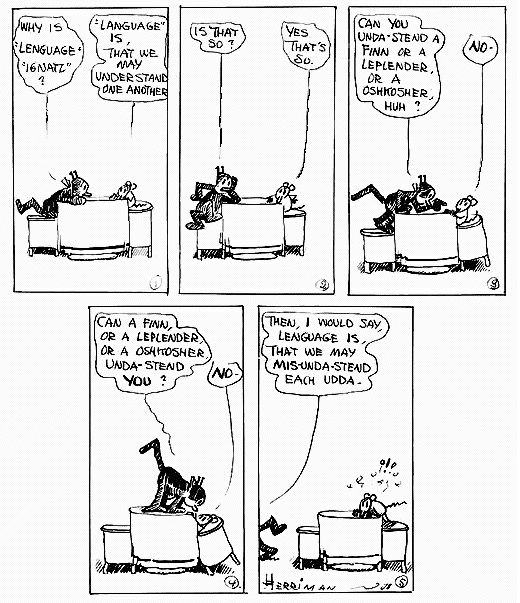
"Language" is, that we may understand one another. Is that so? The brilliant George Harriman, courtesy of the tireless y2karl (via MetaFilter).
For some time, prodded by the unending debates I get into about English usage, I have contemplated writing a long entry in which I would set out the arguments on either side and steer a reasonable course between the extremes, giving such convincing examples that readers would understand at last, and hopefully even stop whining about "hopefully" (and "disinterested" and "hoi polloi" and all the rest of the shibboleths). Thinking about this tired me out, and I would read a good book instead. Now, as so often happens, procrastination has paid off, and I no longer have to do the oft-postponed task.
This is because I've finally gotten a copy of The American Heritage Dictionary of the English Language, Fourth Edition (online for free, but I always prefer physical books, and this one is beautifully produced), and discovered the brilliant essay on usage by Geoffrey Nunberg. Nunberg, whom I have recommended before, is a linguist who understands the prescriptivist arguments and even accepts some of them (at times I had to swallow hard while reading, but I never rebelled); his ideas are sensible, probably more so than mine would have been, and should convince all but the most closed-minded. The first three paragraphs should give an idea of what he's up to:
Viewed in retrospect, controversies over usage usually seem incomprehensibly trivial. It is hard for us to fathom why Swift should have railed against the shortening of mobile vulgus to mob, why Benjamin Franklin should have written to Noah Webster complaining about the use of improve to mean “ameliorate,” or why Victorian grammarians should have engaged in acrimonious exchanges over whether the possessive of one should be one’s or his. Even comparatively recent controversies have a quaint air about them: most people under 50 would be hard-put to understand what in the world critics of the 1960s had in mind when they described the verb contact as an “abomination” and a “lubricious barbarism.” This does not necessarily mean that there was never any substance to these controversies—or that there is nothing of importance at stake in the issues that modern critics worry over, even if it is certain that most of them will strike our successors as no less trivial than Swift’s and Franklin’s complaints seem to us. In his time, Swift may have been within his rights to complain about mob, which began as an affectation of aristocratic swells. The fact that the word later settled into middle-aged respectability doesn’t retroactively excuse its youthful flippancy. And contact started as business jargon before it was generally adopted as a useful verb. Perhaps current jargon like incentivize will develop along the same lines, but it doesn’t follow that critics have no justification for objecting to it now. Past controversies should put us on our guard against viewing these disputes too narrowly. Disputes about usage are always proxy wars. What is important is not the particular words and expressions that critics seize on at a given moment but the underlying mental vices that they (often temporarily) exemplify—for example, foppery, pretension, or foggy thinking. Language criticism is instructive only when it takes words as its occasion rather than as its object.I'll add that I've loved the AHD since its very first edition, which came out while I was in college and just discovering Indo-European; not only did this dictionary have illustrations in the margins and helpful (if sometimes prissy) Usage Notes, it had an appendix listing all IE roots that gave rise to English words. (I still have my much-annotated original copy of that appendix.) The Fourth Edition has gorgeous color illustrations, much less prissy Usage Notes, and a Semitic appendix to go along with the IE one. (Did you know that Hebrew magen 'shield,' as in "magen David," is from the same root as Arabic jinni 'djinn, demon'? It's West Semitic *gnn 'to cover.'). I recommend it to one and all without reservation.
This remarkable flash presentation not only teaches you how to bow correctly, it takes you through the entire complicated ritual of visiting a Japanese company, being introduced, presenting business cards, &c., accompanied by appropriate spoken dialog (with subtitles) and sidebars containing all sorts of relevant information (for instance, you should never write with red ink, since it was used for death sentences in ancient China and is considered highly inauspicious). Via plep.
For more information on various types of bows, including the extreme saikeirei, rarely seen since Imperial days, and appropriate contexts ("[A] bow accompanies all greetings and is a response to all offers, compliments, and a number of other behavioral patterns. To say Arigatogozaimashita 'Thank you' and not to bow is strange"), read the excellent little essay "Bowing, the Japanese Custom" by Tomoko, a student in Francis Britto's English Composition class. I hope she got an A.
The Discouraging Word today explores the brief history (three recorded occurrences) and hard-to-pin-down meaning of a word that must have been in fleeting vogue in the fourth decade of the nineteenth century. You might also want to scroll down (none of your newfangled permalinks for TDW!) to the April 21 entry "Wonky pillars, and why the OED no longer considers us polite" for an exegesis of the more current, if not exactly familiar (to Yanks), word "wonky."
Mamoun Sakkal has an excellent short history of Arabic writing and calligraphy. (Via Eclogues.)
Addendum. Directly below the Arabic link at Eclogues is one to The New and complete manual of Maori conversation : containing phrases and dialogues on a variety of useful and interesting topics : together with a few general rules of grammar : and a comprehensive vocabulary (Wellington, N.Z.: Lyon and Blair, Printers, Lambton Quay, MDCCCLXXXV, Rights Reserved). Sample exchanges:
Here is some good wine
Tênei tetahi waina pai rawa
I am a teetotaller, and do not taste wine
He titotara ahau, e kore ahau e inu i te waina
Are you fond of shooting?
Ka nui tōu pai ki te pupuhi?
Very fond
Nui rawa atu
La grande rousse emphasizes for the benefit of lazy pluralizers that there is no such word as "chevals"; in so doing, she links to an interesting brief entry at the Banque de dépannage linguistique of the Office québécois de la langue française, which in the course of explaining why the word is chevaux clears up a detail I had never thought to wonder about, namely why -x is used for plurals in the first place. It seems that the ending -us resulting from the pre-French change of /l/ to /u/ before another consonant was written by scribes with an abbreviation that looked like an "x"; later scribes, thinking it was in fact an "x," wrote it that way, so that what had been "chevaus" now read "chevax." Still later copyists thought a "u" had been omitted and inserted it, producing "chevaux," which became established—just one of the bits of weirdness that make the French one of the few peoples on earth who cannot plausibly make fun of English spelling.
Yemsa is a minor language of Ethiopia, the language of the former kingdom of the people who call themselves Yamma and were absorbed into Ethiopia in 1894; people, kingdom, and language are traditionally called Janjero or Zenjaro, an insulting Amharic term meaning 'baboon.' A book by G.W.B. Huntingford, The Galla of Ethiopia: The Kingdoms of Kafa and Janjero, contains the following description (quoted in Andrew Dalby's Dictionary of Languages, p. 475) of a remarkable feature of the language:
The royal language of Janjero consisted of a special vocabulary for parts of the body, weapons, and verbs of action referring to the king. Thus "eye" in common Janjero is afa, but kema in the royal language; "eat" is ma in common speech, bos in the royal language; and "spear", ebo in common speech, is me'a in the royal language. The language of respect used special words to describe the ordinary actions of notables: "eat" is ma in common speech, but ta in the language of respect. Improper use of the royal language was punished by death.A special court vocabulary is an element of a number of East Asian languages (Japanese and Javanese spring to mind); I imagine there are other African examples, but this is the first I've come across, and in quite a remote little kingdom. Surely someone must have done a general study of this phenomenon.
In an earlier entry I referred to the Sapir-Whorf hypothesis, which says that the way we see and think about the world is influenced (in the moderate version) or determined (in the strong version) by the language we speak. A short article by Daniel Chandler summarizes thus:
Whilst few linguists would accept the Sapir-Whorf hypothesis in its 'strong', extreme or deterministic form, many now accept a 'weak', more moderate, or limited Whorfianism, namely that the ways in which we see the world may be influenced by the kind of language we use. Moderate Whorfianism differs from extreme Whorfianism in these ways:(Other discussions here and here, here is a collection of old LinguistList posts on the topic, and Stavros has a recent entry discussing it in relation to Korean hierarchical forms of language.)
* the emphasis is on the potential for thinking to be 'influenced' rather than unavoidably 'determined' by language;
* it is a two-way process, so that 'the kind of language we use' is also influenced by 'the way we see the world';
* any influence is ascribed not to 'Language' as such or to one language compared with another, but to the use within a language of one variety rather than another (typically a sociolect - the language used primarily by members of a particular social group);
* emphasis is given to the social context of language use rather than to purely linguistic considerations, such as the social pressure in particular contexts to use language in one way rather than another.
I have no new insights to offer regarding the hypothesis itself (though I will say that the Chomsky-Pinker outright dismissal of it is based on their assumption of the underlying identity of all languages, which I consider absurd.) I would, however, like to mention an experiment I carried out in my college years, when I was too ignorant to realize I had neither the experience nor the resources to do a good job of it. I copied a number of illustrations of simple scenes, simple enough that there were only a few elements to describe (a woman getting water from a well, a man going through a door, that kind of thing). I then showed the series to native speakers of as many different languages as I could find on my (fortunately very diverse) campus and asked them to write one-sentence descriptions in their native languages. My hope was to show skewing of description that would correlate with the grammatical structures of their languages; as I recall, the results were suggestive but not conclusive (and how could they have been, given that I was wet behind the ears and stumbling around in the dark?). But it seems to me that a similar experiment, done by people who knew what they were doing, could provide some valuable insight, more valuable than the simple asseverations that pass for argument at present. If anyone knows of work along those lines, please let me know. And if anybody thinks I'm talking through my hat, they're probably right. All comments are welcome.
Rara Avis illustrates an entry on the former hierarchy of languages in Finland with this photo of a trilingual street sign, which reminds me of my only visit to Helsinki, back in 1971. At that time nobody in the city seemed to speak English, and I spoke no Finnish or Swedish, so the only common language available was Russian—except that nobody in Finland wanted to speak Russian (except for the aged caretaker of the Russian Orthodox cathedral), so I was effectively cut off from verbal communication. A very strange experience. (When I say I spoke no Finnish, by the way, I exaggerate slightly. I had painstakingly taught myself one Finnish sentence, which still rolls easily off my tongue over 30 years later: Puhutteko englantilainen englantia? Do you speak English? [Thanks for the correction, Dmitri!] Alas, the response to my fluently produced query was invariably a flood of incomprehensible Finnish. Belatedly, it dawned on me that the only useful sentence in that context is "Do you speak English?" In English. Live and learn.)
In an entry today, incidentally, Rara refers to the Academic Bookstore, which is apparently the Foyles of Helsinki; I suspect it's the huge bookstore where I found all the Russian books I'd been unable to find in Russia itself (these were the days when the only books available in Soviet bookstores were the complete works of Lenin and whatever books had just been published that week—unless they were of any interest, in which case they had vanished within minutes). Thanks for the trip down memory lane, Rara!
From Charles Olson's Maximus Poems:
Last, he with muscle as big as his voice, the strength of himfrom Letter 2.
in that blizzard
to have pulled the trawl slack from the very bottom and released
his mate from the cod-hook had him out, and almost off,
into the snow. It wasn't that there was so much sea. It was the cold,
and that white, until over the dory went and the two of them,
one still,
were in. The wild thing was, he made the vessel, three miles, and fetched her,
found that vessel in all that weather, with his fellow dead weight
on him. The sort of eye
which later knew the Peak of Brown's
as though it were his own garden (as Bowditch brought the Eppie Sawyer
spot to her wharf a Christmas morning)
It goes to show you. It was not the "Eppie Sawyer". It was the ship "Putnam". It wasn't Christmas morning, it was Christmas night, after dark. And the violent north-easter, with snow, which we were all raised to believe did show Bowditch such a navigator, was a gale sprung up from W. hit them outside the Bay, and had blown itself out by the 23rd.(Exit Olson, enter Languagehat.) Facts are hard to come by, and we all twist, but it's refreshing that he took the trouble to straighten it out, no? (Exit, pursued by a postmodernist.)On the 25th it was fog Bowditch had to contend with. The wind was NE allright, but there is no mention of snow[...]
1
He sd, "You go all around the subject." And I sd, "I didn't know it was a subject." He sd, "You twist" and I sd, "I do." He said other things. And I didn't say anything.
Anyone who, like me, has been inspired and energized by Shelley's consistently excellent writing and thinking over at Burningbird should be aware that she's in danger of losing her forum, her microphone, her virtual voice. Jonathon Delacour has set up a PayPal fund for her; you can click on the button below or go to his site if you want to contribute. Burn on, Shelley!
Update. The campaign has been very successful, and Jonathon has removed the PayPal button and asked others to do likewise. I'd like to join him and Shelley in thanking anyone who contributed to the fund; it's heartening to see the oft-derided "internet community" act as a community. Kudos all around.
(You all do know that kudos is a singular, right? Don't voice that final -s!)
Jonathon Delacour, at the heart of things, has a brilliant post about a genre of Japanese novel called shishōsetsu, the "I novel," which uses "the techniques of essay, diary, confession, and other non-fictional forms to present the fiction of a faithfully recorded experience" and is apparently a basic component of the Japanese understanding of what a novel should be. After an analysis of the phenomenon itself, he ties it in to the truth in blogging issue that has been roiling a section of the community. Read it and think.
Go over to Laputan Logic and read today's clear, illustrated entry (you may have to scroll and/or hit Stop; John's trying out a stylesheet-based system, and it's very slow and wonky).
A sample:
By the 4th century things were really starting to go a little pear-shaped. Fortunately, Rome fell not long after and order was restored in the 8th century with the standardization of Carolingian Minuscule & Majuscule under the learned despotism of Charlemagne (although we should not fail to mention at this point that cute Irish script that you still see today adorning every theme pub from Boston to Bangalore).Alas, the barbaric Goths could not be held at bay for long and even the Franks themselves eventually succumbed to their inner Germanity thus ushering in a Dark Age of condensed and nasty pointy black letters.
It took the cultural re-emergence of Renaissance Italy to finally reject the Northern Gothic style and to reassert the earlier rounder letter shapes. The Humanists took the Carolingian writing as its model (largely in the mistaken belief that it was the style of the ancient Romans). In concert with the contemporary revolution brought by the printing press, this Humanist style eventually supplanted the Gothic style throughout the whole of Europe and went on to become the basis for the typefaces that we still use today and its cursive form the basis of our handwriting style.
The literary journal Two Lines has been around since 1994, but I only recently discovered it (at a small-press expo here in NYC). Each issue is organized around a theme (the three most recent are "Crossings," "Cells," "Ghosts"), and they present everything bilingually—completely in the case of poetry, usually only the first page in the original for prose. You can see the complete list of issues here, and clicking on the Contents link will tell you what's in each (here, for example, is the 2002 issue); the actual content is not online, but it's a venture worth shelling out to support. And if the theme of the next issue appeals to you, you might want to submit something; it's too late for this year's "Parties" issue, but I imagine they'll have a theme for 2004 up soon.
In my perusal of the OED, I have run across the most extreme example I've seen of disparity between the weight of scholarly apparatus brought to bear on a word and the fugitive nature of the word itself, which occurs once in the 15th-century morality play The Castle of Perseverance. Ordinarily, I'd urge people to start putting the word back into use, to justify the labors of the OED's etymologists, but since the word is an abusive term for a woman, that won't do. At any rate, here's the entry (warning: the following contains both misogynistic language and rank etymological speculation):
motyhole, n. Obs. rare–1. [Origin uncertain. The second element is app. HOLE n.; the first element is perh. MOTEY a. (although this is first attested much later) with sense ‘dusty, dirty’, or perh. MOTHY a.1 (although this also is first attested much later; cf. form mote s.v. MOTH n.1), or perh. related to Frisian mot sow, female rabbit, ungainly person (also in the compound motbaarch, slut, slattern, lit. ‘sow-pig’), Middle Dutch motte, mutte sow (Dutch mot (regional) sow, (arch.) loose woman, whore), Middle Low German mutte, motte sow (German regional (Low German: East Friesland) Mutt, Mutte sow, German regional (Low German: Westphalia) Mutt (slang) vulva), Middle High German musse loose woman, whore (German Mutze (slang) loose woman, whore, vulva), of uncertain etymology.] As a term of abuse for a woman: a slut, a bitch. a1450 Castle Perseverance 2120 Therfor, fast, fowle skowte, Putte Mankynd to us owte, Or of me thou schalt haue dowte, thou modyr, thou motyhole!There is a modern English translation here, which renders the lines in question thus:
Therefore, fast—foul scum—"Suck-hole"? The OED says "(a) ? (see quot. 1626); (b) U.S., a whirlpool, a pond; (c) Canad. and Austral. slang, a term of abuse (cf. SUCK n.1 12)"; I presume the third sense is intended. But if you ask me, they should have kept "motyhole." After all, it's in the dictionary.
Put Mankind thee from,
Or I'll beat thee like a drum,
Thou mother! thou suck-hole!
Although entirely irrelegious myself, I often buy a bible or portion thereof in the languages I study, since the story and much of the wording is familiar, making it an easy read (and of course English translations are readily available if I need a trot). Thanks to Avva, I now have a fantastic resource: online audio bibles in Hebrew, Spanish, Chinese (Mandarin and Cantonese), Polish, Urdu, Hindi, Slovak, and Tagalog, and for lagniappe the Psalms in Arabic! They are mp3 files, broken into chunks for easy downloading; I just spent twenty minutes listening to the first few chapters of Shmot (Exodus) while following along in the New English Bible, and I was astonished at how different the experience was from comparing printed versions. I didn't have to deal with the alphabet, vowel points, &c., I just let the language surround me, depending on the words I knew to serve as mileposts and keep me oriented. And to hear the Lord say to Moses the exact same phrase I hear from Israelis every day on the streets of New York (Ma zeh? 'What's that?') was not only a kick, it gave me a real feel for the continuity of the Hebrew language. Thanks, Avva!
If you want smaller downloads or only want to listen to a chapter at a time of the Tanakh (Hebrew bible), Avva also provides this site; not all the books are up at any given time, but it's a very convenient way to hear the material. (Note: Avva has a couple of links to a site, mechon-mamre.org, that he says has the best version of the Tanakh in various forms, including one without vowel diacritics and one with a parallel English translation, but every time I've tried to access it it's crashed my browser. You have been warned.)
If you're engaged in an internet Easter egg hunt, you need look no further. Thanks to the endlessly creative taz, you are looking at the gorgeous Languagehat Egg. Enjoy!

This egg is intended for aesthetic purposes only; no religious, cultural or metaphysical symbolisms or definienda are expressed or implied. The egg is the creation of its creator, who came first and retains all artistic rights. The word "egg" is from Old Norse and supersedes the native English ey, both being from Common Germanic *ajjaz; no opinion is expressed herein about possible further relations to other Indo-European forms. In no event shall Languagehat, taz, or any of their subsidiaries or affiliates be liable for any incidental or consequential damages based upon negligence, tort, or any other legal theory involving the viewing of this egg. Use only as directed. Selah. V.
wood s lot celebrates the 45th anniversary of Ezra Pound's release from confinement ("A US Federal Court decides since Ezra Pound is incurably, permanently insane, he can no longer be held for treason & can be set free") by posting one of my favorite Pound poems, "The Return" ("See, they return; ah, see the tentative/ Movements, and the slow feet..."); it's at the top of today's entry, just below the photo. Go, read it, and wonder at the perfect match of sound and sense, rhythm and riddle. Myself, I am going to post another of my favorites, "The Spring," which is seasonally appropriate and does not seem to exist on the internet yet:
The SpringThe epigraph (êri men hai te kydôniai 'in the spring the Cydonian') is from a famous poem by the Greek poet Ibycus (6th c. BC), and Pound's poem begins as a loose translation but soon veers off into its own region of anguished longing, "though every branch have back what last year lost" a perfect line in a tradition going back through Landor to the Greek Anthology.Ηρι μεν αι τε Κυδωνιαι—Ibycus
Cydonian spring with her attendant train,
Maelids and water-girls,
Stepping beneath a boisterous wind from Thrace,
Throughout this sylvan place
Spreads the bright tips,
And every vine-stock is
Clad in new brilliancies.
And wild desire
Falls like black lightning.
O bewildered heart,
Though every branch have back what last year lost,
She, who moved here amid the cyclamen,
Moves only now a clinging tenuous ghost.
A couple of details. "Maelid" is not a word, but Pound liked it enough to use it again in Canto III ("Panisks, and from the oak, dryas,/ And from the apple, maelid"); he obviously derived it from Ibycus's unusual word for 'apple-tree,' mêlis (for normal Greek mêlea), which is used in the second line of this poem ("Cydonian apples" was the Greek term for quinces, and the word "quince," originally the plural of earlier "qu(o)yn," is derived, via Middle French and Latin, from Greek kydônios 'Cydonian'). And Cydonian means 'from Cydonia,' Cydonia being the ancient name for a town on the northwest coast of Crete that is now called Khaniá, where I spent several idly delighted days fifteen years ago. So let us welcome spring with Pound and his Cydonian maelids.
Jonathan Edelstein over at The Head Heeb has a great post about a trial in the Bronx County Supreme Court, where a witness—one of a pair of Sierra Leonian brothers who were victims of attempted murder—spoke only Krio, and the court had to decide whether it was an actual language (requiring an interpreter) or just "English with a bad accent." Go to his blog and scroll down to April 14 and the heading "Krio and the courts"; I'd give a permalink, but it would just take you to a 404. (Jonathan, I too was once a hapless sufferer in the world of Blogger; come on over to Movable Type! Oh, and thanks to Barry at Amptoons for the tip.)
Christopher Logue is not exactly unknown, but neither is he at the forefront of many people's consciousness. Too American-influenced for the Brits, too British for the Yanks, unfashionably concerned with form and antiquity, he is respectfully reviewed but not widely loved—not widely enough for my taste, anyway. He is one of the great translators of our time, and one of the great war poets; his life's work is a series of "accounts" (as he calls them) of Homer's Iliad. It began in 1959 when David Carne-Ross asked him to write a script for the BBC based on some Homeric excerpts; not knowing Greek, Logue worked from existing translations, absorbing the story, the ideas, the similes, and reworking them into language that is as fresh and vivid as anything written in my lifetime. I will never forget the moment when I first picked up "War Music" (the ongoing title of the series) and read:
Rat.That's the start of "Pax," his version of Book 19. When I read those lines, I don't care that Homer could not possibly be talking about mosques (at another point "bronze flak" is mentioned, and Aeneas taunts: "Crapulous mammoth!"), I just know that something glorious and true is being said, and (amazingly) something true to Homer. Garry Wills, in his 1992 NYRB review of the first edition of War Music, said:
Pearl.
Onion.
Honey:
These colours came before the Sun
Lifted above the ocean,
Bringing light
Alike to mortals and Immortals.
And through this falling brightness,
Through the by now:
Mosque,
Eucalyptus,
Utter blue,
Came Thetis,
Gliding across the azimuth,
With armour the colour of moonlight laid on her forearms;
Her palms upturned;
Her hovering above the fleet;
Her skyish face towards her son.
Achilles,
Gripping the body of Patroclus
Naked and dead against his own,
While Thetis spoke:
"Son..."
His soldiers looking on;
Looking away from it; remembering their own;
"Grieving will not amend what Heaven has done.
Suppose you throw your hate after Patroclus' soul.
Who besides Troy will gain?
See what I've brought..."
And as she laid the moonlit armour on the sand
It chimed;
And the sound that came from it
Followed the light that came from it,
Like sighing,
Saying,
Made in Heaven.
It is this care in re-creating literary effects that makes Logue's work the very thing he refuses to say it is: the best translation of Homer since Pope's. In fact, on its own partial scale, it is as good as the very best English version, Chapman's, to which it owes a great deal.The latest installment is All Day Permanent Red; there are excerpts here and here. There was recently a staged version that I'm very sorry I missed, and there is a set of recordings that I'd love to hear. Finally, totally unrelated to Homer, there's a mordant little squib called "London Airport." Enjoy.
During the recent unpleasantness in Iraq, bloggers have been quoting from all manner of poets, but unless I've missed something, they've all ignored two of the great English-language war poets of the last century, and I'm here to remedy the omission. I'll start with the virtually forgotten David Jones, who fought in World War One with the Royal Welch Fusiliers and never got over the experience, using it as the backbone for his two great book-length poems, In Parenthesis (1937) and The Anathemata (1952). I shouldn't call In Parenthesis a poem, actually; it's a unique melding of poem and novel, with some passages in prose:
That one went up at an unexpected nearness. The faraway dancing barrier surprisingly much nearer; you even hear the dull report quickly upon the uprising light; and now, right where they walked, at sudden riot against your unsuspecting ear-drums, a Vicker's team discovers its position, by low builded walls of sacks; and men worked with muffled hammerings of wood on wood; and the front files pause again.and others in verse:
Wipers again.The only thing I know remotely like it is Odysseus Elytis's The Axion Esti.
He can't keep off it—like a bloke with a pimple.
What's the use of the place anyway—where's the sense in it.
Don't talk wet.
Who's talking wet.
You're talking wet.
They get warmed to it—they're well away in
tactics and strategy and
the disciplines of the wars—
like so many Alexanders—are perfect in the great comman-
ders names—they use match-ends
to represent
the dispositions of
forces and countermure.
Who's bin reading Land and Water.
Don't nobble Chinese Gordon.
When did they pass you out Hector-boy.
Sheer waste of intelligence—notorious
example of
the man with the missed vocation.
The Anathemata has a wider scope, embracing the whole sweep of history:
Twelve hundred yearsIt still has something to say to us, no? But Jones isn't all trenches and squalor; the one quote from him that I've seen blogged (in the German-language Credo ut intelligam) is this lovely ode to spring from The Anathemata:
close on
since of the Seven grouped Shiners
one doused her light.
Since Troy fired
since they dragged him
widdershins
without the wall.
When they regarded him:
his beauties made squalid, his combed gilt
a matted mop
his bruised feet thonged
under his own wall.
Why did they regard him
the decorous leader, neque decor . . .
volneraque illa gerens . . . many of them
under his dear walls?
What centuries less
since the formative epochs, the sign-years in Saturn's
tellus, in the middle lands of it? For even for the men with
the groma, even for the men of rule, whose religio is rule
for the world-orderers
for the world-syndicate
even for us
whose robbery is conterminous with empire?
On the ste'lyard on the Hill
weighed against our man-geld
between March and April
when bough begins to yield
and West-wood springs new.
Such was his counting-house
whose queen was in her silent parlour
on that same hill of dolour
about the virid month of Averil
that the poet will call cruel.
Such was her bread and honey
when with his darling Body (of her body)
he won Tartary.
Then was the droughts of March moisted to the root by that shower that does all fruit engender—and do constitute what they hallow an' chrism these clerks to minister that kings and queens may eat therof and all poor men besides.
There's an absolutely fascinating interblog discussion going on about the issue of whether, or to what extent, it's acceptable to fictionalize one's life and experiences in one's blog. It doesn't apply to Languagehat, because this is not that kind of blog, but anyone with any interest in the subject (which touches on literature, psychology, elitism, and all manner of meaty topics) should hie them to Burningbird, follow the comments there and at the other sites she links to (especially Dorothea, who is passionately pro-honesty), think about it, and perhaps add their own comments. I mention this also because Burningbird may go dark at the end of April, which is a horrible thought to those of us who love Shelley's writing and the discussions she prompts, and I'm hoping someone reading this will have a hosting opportunity for her (she can't afford the one she's using).
Addendum. An interesting and relevant pro-fiction post from Baldur (via wood s lot):
It will happen slowly, it has to happen slowly. People need to be drawn in. Their hesitant minds, so acclimated to the "non-fiction" of information, news, reality-tv, gameshows and talkshows, need to give up the notion that fiction is made by the few, comes in big packages and in big numbers.Again, I say that's fine, as long as it's clear you're "telling stories" and not (ostensibly) describing the facts of your life and the world.They’re not used to the idea of fictional stories being told by normal people to a small crowd.
Like virgins, they need to be approached with great care, and treated gently, so as to not turn them off the very concept for the rest of their lives.
Before they know it, we’ll be having them telling stories with the best of them.
I'm frustrated that the interblog conversation has died down, and I think I'll post a couple of my comments here so that I won't have to go searching through Outer Blogovia to try to find out what I think.
From Burningbird:
Let me come at it from another angle. In textual criticism there's a principle called "lectio difficilior potior"—the more difficult reading is the stronger. The idea is that the original text will have had odd, unpredictable words or phrases that tended to get smoothed out when the text was copied, so that if you have two versions, one with a dull, obvious word and one with a striking, unusual one, the latter is preferable (other things being equal). Similarly (if you buy my analogy), life deals us unique circumstances, events, reactions, that we could never have made up or predicted and that if recounted truthfully can strike new and resonant chords in the hearer; when we reinvent them, "improve" them, like those ancient scribes we are likely to introduce easier readings that make a duller text. Hew to the lectio difficilior, however difficult it may be for you, and you will be read and treasured.In response to Shelley's quoting this passage of Annie Dillard in a later Burningburd entry:Another way of looking at it: frequently, in the Jewish scriptures, the Lord calls on a prophet to tell him to do something or other, and when the prophet answers the Lord's call, he does so by saying "Hineni": Here I am. He doesn't go on about the weather, or give long explanations of his situation, or practise any sort of bullshit whatever. Just "here I am." I think that's what we unconsciously expect from bloggers (unless they're patently doing something else): that they're saying to the world "here I am, with all my faults, quirks, and general weirdness." Otherwise, what's the point? You're just another mask in the crowd.
Posted by: language hat on April 16, 2003 02:11 PM
I used to have a cat, an old fighting tom, who would jump through the open window by my bed in the middle of the night and land on my chest. I'd half-awaken. He'd stick his skull under my nose and purr, stinking of urine and blood. Some nights he kneaded my bare chest with his front paws, powerfully, arching his back, as if sharpening his claws, or pummeling a mother for milk. And some mornings I'd wake in daylight to find my body covered with paw prints in blood; I looked as thought I'd been painted with roses.and adding "Sometimes to tell the truth you have to lie a little," I responded:
"But I understand why she created this story. What could better bring together the child and her wonder and acceptance with an example of wildness, of nature's violence blended with beauty. Sometimes to tell the truth you have to lie a little."And from Jonathon Delacour:I understand why she created it, too; what I don't understand is why she put it in the first person. Why not say "A cat, an old fighting tom, jumps through the open window by your bed..."? There are all kinds of ways you can frame an image like that; the only point to telling it as something that happened to you personally is to give it that added authority of personal experience, and in this case that is a lie. It's possible that "Sometimes to tell the truth you have to lie a little," but I'm quite sure that the number of cases in which it's true is dwarfed by the number of cases in which somebody is using it as a cover for making things easier on themselves or making themselves look more impressive, the usual reasons for lying.
Look, I write about language on my blog. What if I described a really fascinating language, one with a poetic structure that made you think differently about the possibilities of being a linguistic animal? And what if you then discovered I'd made it all up? If that would upset and disappoint you, why should there be a different standard for describing one's own life? If you're fantasizing, speculating, imagining, that's great, but be upfront about it. If you're saying "Here I am, and this is what happened to me," then you should be telling the truth as you see it. (Yes, yes, no such thing as objective truth, bla bla, that's not the issue here. Telling the truth as you see it is hard enough, and a worthy goal.)
In short, I'm with Dorothea; I don't have her personal history or set of fears and demands on herself, but I feel strongly that honesty is one of the most important things we expect and deserve from each other, and arguments to the contrary are usually covers for agendas that don't look so appealing without the cover.
Posted by: language hat on April 18, 2003 11:48 AM
"...when I read his stories it's irrelevant whether the events occured exactly as he describes them, I simply wish to surrender to his narrative voice."Finally, Dorothea has two more posts on the subject.But don't you think it's possible that it's because of his commitment to truth that his narrative voice is so compelling?
Posted by: language hat on 16 April 2003 at 03:40 AM
Potawatomi is a member of the widespread Algonquian (or Algonkian) family; the Potawatomi people started out around Lake Michigan but were forced into reservations elsewhere. I recently ran across the potawatomilang.org website, which includes an excellent grammar section, well worth the while of anyone interested in Amerind languages.
For some time I've been noticing a new slang word, "hella," used as an intensive in all sorts of circumstances: "It cost hella money," "That was hella cool," &c &c. Now, thanks to thatweirdguy2 (posting in a MetaFilter thread), I've seen this paper by Rachelle Waksler and I know a lot more about it. I don't plan on trying to use it myself; I'd just sound stupid. But keep right on reinventing the language, kids!
Addendum. A MetaFilter thread from last year traces the word back to the '70s (!). It's also a very funny thread.
Not only a history of the street names in the tiny, beautifully preserved old Czech town of Cesky Krumlov (the first C- has a hacek and is pronounced ch-), this site has pictures of each street, often side-by-side old and new photos taken from the same vantage point. I wish all old towns and cities had such websites, but it's a good thing they don't, because I'd spend all my time immersed in them. Thanks for this wonderful site go to wood s lot.
(Incidentlly, the town is next to Ceske Budejovice, original home of Budweiser beer—Budejovice=Budweis in German.)
The Duck
Behold the duck.
It does not cluck.
A cluck it lacks.
It quacks.
It is specially fond
Of a puddle or pond.
When it dines or sups,
It bottoms ups.
The British Library/University of Washington Early Buddhist Manuscripts Project "was founded in September 1996 in order to promote the study, editing, and publication of a unique collection of fifty-seven fragments of Buddhist manuscripts on birch bark scrolls, written in the Kharosthi script and the Gandhari (Prakrit) language that were acquired by the British Library in 1994. The manuscripts date from, most likely, the first century A.D., and as such are the oldest surviving Buddhist texts, which promise to provide unprecedented insights into the early history of Buddhism in north India and in central and east Asia." I discovered this project through an article posted by John Hardy in his wonderful and endlessly varied blog Laputan Logic, which takes forever to load (any of you blog mavens out there want to give him helpful tips?) but is well worth it; recent posts have included fugu, the Jehoash Inscription, Udaipur photos, perpetual motion, and the Euphrates and Tigris rivers, and in the past he's discussed non-round protons, the planet Quaoar, and, well, go see for yourself. Just hit Stop when you get tired of waiting for the damn thing to finish loading.
Addendum. I have shamed John into fixing his own blog, and it now loads in a jiffy!
From the sample texts page:
bhayea mitra padibhanavamtaI doubt I'll ever be able to abandon doubt, so I'll probably never get to wander alone like the rhinoceros. Just as well.
bahosuda dhammadhara urada
(*anae dhammam vi)yigitsa prahae
ek(*o care khargavisanagapo')One should cultivate a friend who is intelligent,
learned, a master of the dharma, noble.
(*Having understood the dharma)
[and] abandoned doubt, (*one should wander) alone (*like the rhinoceros.)Verses 24-26 of the Gandhari "Rhinoceros Sutra" (*Khargavisana-sutra); from R. Salomon, A Gandhari Version of the Rhinoceros Sutra (Gandharan Buddhist Texts 1; Seattle, University of Washington, 2000).
Everything you wanted to know about Chinook Jargon in one remarkable website. Via taz. A bit of history within:
In the year 1810 John Astor established a fort at the site of the present town of Astoria. Being near the mouth of the Columbia River, it was an ideal spot for his "Pacific Fur Company." He employed a number of Canadian French, along with some Ojibway and Iroquois Indians from the east. In three years Fort Astoria became the property of the British Northwest Fur Company, which merged with the Hudson's Bay Company in 1821. In 1824 the Hudson's Bay post was established at Fort Vancouver.Natives from the interior and along the coast always played an integral role in the fur trade, the men being trappers or middle-men, and the women often negotiating the exchanges for goods with other Indians or the fur companies. The lingua franca for these dealings was the developing Jargon. Many of the French gradually left the fur companies and took up farming in the Willamette Valley, among other trades. Marriage with native women from far and near was common and communities were formed in which there was no common language other than "Chinook Jargon." The first language of these children was "Chinook."
By the 1840s there seems to have been, for the most part, a fairly standardized vocabulary which was actually being referred to as "Chinook Jargon."
Via Pensate Omnia:
The purpose of rhythm, it has always seemed to me, is to prolong the moment of contemplation, the moment when we are both asleep and awake, which is the one moment of creation, by hushing us with an alluring monotony, while it holds us waking by variety, to keep us in that state of perhaps real trance, in which the mind liberated from the pressure of the will is unfolded in symbols. If certain sensitive persons listen persistently to the ticking of a watch, or gaze persistently on the monotonous flashing of a light, they fall into the hypnotic trance; and rhythm is but the ticking of a watch made softer, that one must needs listen, and various, that one may not be swept beyond memory or grow weary of listening; while the patterns of the artist are but the monotonous flash woven to take the eyes in a subtler enchantment.From Yeats's 1900 essay "The Symbolism of Poetry."
People should be more aware of Abu Rayhan al-Biruni, the great scientist from Khwarezm (south of the Aral Sea) who accompanied Mahmud of Ghazni on his conquest of India in the 1020s and wrote a comprehensive account of that country. "Biruni's works cover essentially the whole of science at his time. Kennedy writes:"
... his bent was strongly towards the study of observable phenomena, in nature and in man. Within the sciences themselves he was attracted by those fields then susceptible of mathematical analysis.But what is of immediate interest here is his linguistic accomplishment. Not only did he write many, many books in Arabic and Persian (neither of which was his native language), but on the trip to India he learned Sanskrit, not only translating sacred Hindu books into Arabic but translating Euclid's Elements and some of his own works into Sanskrit! Now, that's impressive.
I got onto the subject through this remarkable entry at Odd Things in Pitt's Libraries:
The Exhaustive Treatise on Shadows by Abu al-Rayhân Muhammad b. Ahmad al-Bîrûnî: Translation & Commentary by E.S. Kennedy, published by the Institute for the History of Arabic Science, University of Aleppo (Syria), 1976.from the preface: "Copy for photo-offset printing was turned out in Beirut simultaneously with the development of the Lebanese civil war. The concomitant difficulties provide a blanket excuse to cover the manifold shortcomings of the result (the bizarre format of this page, for example). Moreover, the milieu in some ways appropriately resembled that of the wars of Sultân Mahmud, and the vicissitudes under which al-Bîrûnî (973?-1048) brought forth the original of this work."
Fourth floor, Hillman
I don't even know how to start telling you about Carl Masthay and his obsessively compiled and self-published Kaskaskia Illinois-to-French Dictionary. Just go read the Riverfront Times article (by Matthew Everett); you'll laugh, you'll cry, you'll wonder how he finds girlfriends, you may even wind up sending him $30 for the book. No rush; it's not selling out any time soon. (Thanks to the indefatigable Bob Cohen for the tip, and to Prentiss Riddle for the dictionary link.)
Addendum. I just (Jan. 2006) discovered the Everett article has migrated to another URL; having at first thought it had vanished, I believe I'll reproduce some of it here just in case:
For Masthay, though, the dictionary—more than twelve years in the works—is a final, monumental validation of the decades he's spent looking into the hidden corners of language. Through his self-financed and often obsessive research, Masthay has marked out a peculiar and far-reaching patch of intellectual territory, becoming something of a local legend in the process for his intelligence and his eccentricities.As someone who also "occupies a nebulous place among professional scholars," I salute his dogged and unremunerative efforts.Masthay, 62, came to St. Louis in 1967 after a stint in the U.S. Air Force. He enrolled in graduate school at Washington University, working toward a master's degree in Chinese. After a year at Wash. U., he went to work at the Mosby publishing company, editing medical texts. He stayed there 33 years, retiring in January 2002. Outside work, he pursued his other interests: biology, astronomy, entomology, archaeology and, in particular, foreign languages.
"I see languages as tools to understand the universe, to understand other people's cultures," he says, rubbing his temples as he searches for the exact words he wants. "As a kid, I saw them as codes. I want to know what they're holding."
Over the years, Masthay has become a familiar figure on the academic circuit. He counts professors at major universities all over the world as his friends. His living room is cluttered with journals and science magazines, in addition to hundreds of compact discs (mostly world and ethnic music), his own notebooks and photocopied pages of poems, puns and etymologies. He claims fluency in five languages—French, German, Chinese, Spanish, Russian—and competence in dozens more, with texts in Russian, Arabic, Chinese and Japanese lining the shelves in his house.
Masthay occupies a nebulous place among professional scholars; he's not quite an equal, but many of them appreciate his efforts and consider him a respected contributor to their fields.
"People cite his work. They trust it enough to cite it," says linguist David J. Costa, who works with Indian tribes to revive dormant languages. "He's not a linguist in the sense that he has a degree in linguistics, but he's a linguist in the sense that he speaks a lot of languages. The consensus seems to be that he's a very reliable editor, a skilled translator, and he's almost insanely meticulous. And when you're preparing a scholarly edition of a 300- or 400-year-old manuscript, that attention to detail is essential." (Masthay would dispute Costa's characterization of his credentials. He says the work he did to transcribe another Indian document, Schmick's Mahican Dictionary, would have been enough to qualify him for a doctorate.)
Teresa Dowlatshahi has a new comic using words in foreign languages that sound like English ones; today's installment, for example, describes the Lardil word weel as meaning 'big clouds (that come out of the east in the summer)' and shows several whale-shaped clouds floating over a landscape. Fun.
Dorothea Salo over at the always interesting Caveat Lector is generously providing a series of lessons in Movable Type for rank beginners (such as myself). So far there have been What’s a Movable Type template?, Anatomy of a template, Preferences and placeholders, and Container placeholders; you can follow the series here. I'm sure I speak for many when I say: thanks, Dorothea!
Anyone in the New York City area should be aware of the program coming up May 2-29 at the Walter Reade Cinema in Lincoln Center, Films from Along the Silk Road: Central Asian Cinema.
Addendum. Anthology Film Archives is in the middle of Voices Of Dissent In Arab Cinema: A Selection Of Films By North African Directors; oddly, there is nothing about it on AFA's own site, but here's a review from the Village Voice.
More on the Central Asian program:
Between the Middle East and the western Chinese border lies a vast stretch of the continent that has barely registered on the western cultural radar. This is the world where Genghis Khan ruled, and through which the great trade route called the Silk Road ran. The five former Soviet Asian republics are known to some as "the stans" - Turkmenistan, Tadjikistan, Kyrgyzstan, Kazakhstan and Uzbekistan, linked by geographical proximity yet each possessed of its own unique culture. And its own distinctive national cinema.Unfortunately, they don't identify which language the films are in, and many of them may be in Russian, but at least some of them are (judging by the titles) in local languages. A notable event:Chances are you've never heard of most of the films in this series, the first comprehensive retrospective of movies from this cinematically rich corner of the world. You may wonder why. The reason is nothing more or less than an accident of history. When the Soviet Union collapsed, so did the apparatus for the promotion and distribution of films from Central Asia. Every time the films have surfaced, it's been the result of a titanic effort on the part of a few valiant scholars, programmers, and festival organizers. But the films are worth the effort. These countries are as culturally rich as they are cash poor, and the films, from throughout the region, are hand-crafted wonders, rich in artistic and poetic miracles.
As a special feature of this series, we are paying tribute to the late Kyrgyz director Tolomush Okeev, one of the greatest "open-air" filmmakers who ever worked in the medium. We will also be showing WITHOUT FEAR and MAN FOLLOWS BIRDS, two extraordinary films by the Uzbek master Ali Khamraev, not to be missed. We are also featuring a special presentation of TAKHIR AND ZUKHRA, an enchanting 1944 Uzbek film that will leave you breathless. And you will be seeing films by directors like Darezhan Omirbaev, Serik Aprymov, Amir Karakulov and Ermek Shinarbaev from Kazakhstan, Aktan Abdikalikov and Marat Sarulu from Kyrgyzstan, Jamshed Usmonov from Tadjikistan and Khodjakuli Narliev from Turkmenistan, and many others whose names you may not know but whose films you will never be able to forget.
We expect many of the directors to be present for Q & A. Please check back on this page for updated information about guest appearances.
SYMPOSIUM 1: MAPPING THE HISTORY OF CINEMA IN CENTRAL ASIA
This symposium will explore the unique history of filmmaking in the five former Soviet republics of Central Asia, from the silent era through the present. Guests include: Neya Zorkaya, film historian, Russia; Tynay Ibragimov, director of Kyrgyz Film Studio; Ali Khamraev, director, Uzbekistan; Hadjikuli Narliev, director, Turkmenistan; Ardak Amirkulov, director, Kazakhstan.
Sat May 3: 10 am
Here's a little quiz. What language was spoken three centuries ago by the Jewish community of Istanbul? Of Bordeaux? Of Hamburg? (Hint: three different answers.)
Answers (and much more) within....
The first answer is easily guessed by anyone who knows the basic history of the Sephardic community: Ladino (Judeo-Spanish). The second is not surprising to those who know the assimilative capability of France: French. The third answer surprised the hell out of me when I learned it: Portuguese.
The best-known Sephardic community is that from Spain (Sepharad is a Hebrew term that occurs once in the Bible and eventually became used for Spain). As everyone knows, it was expelled in 1492; some went to Portugal, but the same thing happened there five years later. The bulk of the community went to North Africa (where some still speak the dialect called Haketia), from which many later moved eastward into the Ottoman Empire and concentrated in cities like Constantinople, Alexandria, and Salonica. There, where they lived in large numbers and were not competing with significant preexisting Jewish communities, they kept their Spanish language, larded with Hebrew and, more and more, with borrowings from the languages that surrounded them: Turkish, Persian, the Balkan languages, and eventually Italian and French. It was primarily a spoken language, written down at first only in word-by-word paraphrases of Hebrew texts (parallel to the Taitsch used by the Yiddish-speaking community), but became a literary vehicle with the publication of the Me’am Lo’ez, an extensive commentary on the Torah, in the 18th century. There are Ladino links here and a grammar here, there is an anthology whose introduction provides a good sample of Ladino if you want to try reading some, and Hippocrene publishes a bizarre and delightful dictionary.
Those who went to Western Europe, however, mainly spoke Portuguese, which was the language of the communities in the Netherlands, England, Hamburg, and (at first) France, as well as of those who emigrated to the Americas (including New Amsterdam, now New York). Spinoza's mother tongue was Portuguese. As I say, I had no idea, and I am glad to have my picture of linguistic history still further complicated.
Addendum. The implausibly polyglottal Bob Cohen reminds me that Sephardim also spoke Judeo-Italian, Judeo-Provencal, and Romaniote Judeo-Greek; see his comment for further info. (There are also Judeo-Persian speaking communities, notably the "Bukharan Jews," but including them as "Sephardim" is controversial.)
Colin Brayton has started a new collective blog to remedy the status quo, which is (as he says) that "The global blog village remains ghettoized and anglocentric."
What I envision is a game of linguistic six degrees of separation in which I, with my English, Portuguese, Arabic, and French, could read about memes propagated in Chinese from someone with, say, Chinese, French, and German, and pass on memes from Arabic and Brazilian Portuguese to English blog browsers.Sounds like a worthwhile project; go on over and see what's up.As Beth Luey notes, however, in Translation and the Internationalization of Culture,
Objections to the internationalization of culture are based on the belief that what is taking place is, in fact, not internationalization but Americanization.In that light, of course, it is really we Anglophones who need to be internationalized, and I anticipate that, like all blogs, the main mass audience for this project would initially be Anglophone. There's a bit of a catch-22 there, since for the project to work, many non-Anglophones must be involved. We will need collaborators to run community weblogs in other languages on this site to request comments and propagate the meme.
Here it is, folks. The move would have been impossible without the infinite patience and coding wizardry of Songdog, without whom this e-ignoramus would still be rootling around in the swamp of igbloggery. (No, it's not a word, but I like it.) The glorious logo at the top of the page, with its swooping (and in places hatlike) calligraphy against a subtly colored cuneiform background, is the work of the amazing taz; go visit Citrus Moon and admire. I am grateful to them for making this project less daunting to me, and I hope the final result is pleasing to all Languagehat aficionados. Pull up a chair, and let's talk language.
If you're a lover of typography, you'll want to bookmark this site; find a capital Q in the text whose type you want to identify, answer a question about it, and you're started on a journey that will end in satisfaction. (If it doesn't, let them know—they're always adding new fonts.) Thanks, Chris and Songdog!
This is from Dark World, a 1974 book by one of my favorite American poets, Hayden Carruth (also editor of my favorite American anthology, The Voice That Is Great Within Us); Dark World has an epigraph from Rabbi Baruch of Mezbizh: "What a good and bright world this is if we do not lose our hearts to it, but what a dark world if we do!"
STEPPING BACKWARD
I waken and
lean and look out
to see the darkness
flee,
sunken westward
over curving earth,
departed
like the long ocean
running in tide
so fast and far
it can never return
or darken
this wide shore.
The last green star
dies
and the trees
lean in their green leaves
westward
as if in yearning
and then they straighten.
I rise
from my window
thinking now
the new words I must say
as I step backward
into day.
I just saw Linda Winer interview Rosemary Harris, who knew Laurence Olivier and insisted that he pronounced his name in the traditional anglicized fashion ("oh-LIHV-ee-er," with the ending as in "heavier") and disliked the "oh-LIHV-ee-ay" pronunciation that has become universal ("It's not French!"), though he learned to accept it. (The same is true of the jazz drummer Paul Motian, who used to insist on pronouncing his Armenian name "MOW-tee-an" but finally gave in to the ubiquitous "MOW-shun.") Since I can't find any mention of this on the internet, and all my reference books give the French-style version, I thought I'd better post it here so there will be some record of the fact.
Some of you may have noticed Languagehat was looking distinctly green about the gills lately. I tried my usual amateur haruspication of the template and gave up in despair; Caterina stepped into the breach, waved her magic wand over it, and hey presto!—the poor little blog was good as new, wagging its tail and begging for new entries. All praise and honor go to Caterina the Great, who may be a Fake but is the real thing.
(Comments and archives seem to be missing at the moment, but that's just Blogger being Blogger, I presume. Which reminds me: this little episode has finally gotten me off my lazy butt; I have bought languagehat.com and will be moving to MT soonest. Prepare to update your links!)
It is sometimes said that "primitive peoples" (or welfare mothers, in a particularly obnoxious use of the trope) have a pathetically small vocabulary—a thousand words, perhaps. I've just found an excellent essay by linguist Geoffrey Nunberg (the language maven of Fresh Air, among other things) debunking this nonsense. By the way, although Nunberg doesn't give a figure, the average adult vocabulary appears to be somewhere around 40,000-50,000 words (or, if you believe Steven Pinker, not one of my heroes, something closer to 60,000). (Thanks to Jonathan Mayhew for pointing me in this direction.)
Addendum. Check out the other essays at Nunberg's homepage; there are eminently sensible ones on American attempts to pronounce "Iraq" and "Qatar" (and foreign names in general) and on the use of "Gallic" and other symptoms of our conflicted Francophobia, inter alia.
You thought Yiddish was descended from German? Wrong. It's from Basque. The truth is out there...
Note: Since it is no longer April 1, I'd better add, to clear things up for the overly literal, that the above should be read with eyebrows raised to the maximum level. The linked site is completely loony, despite its neat, professional appearance. As a matter of fact, I wondered if I myself was being taken in by an elaborate joke. I mean, "diaspora (exile, dispersion), .di-as.-.po-ora: adibide (advice) asagotu (to go far away) apokeria (filthy deed) oraintxe (right now): 'The advice is to go right now, far from the filthy deeds'"? "Diaspora" isn't even Yiddish! But naah, it's way too much trouble for a practical joke. It has to be in earnest.
Mea culpa. My deepest apologies. I failed to investigate the linked site further; I was satisfied with the first morsel of yummy lunacy. Moss was not so lazy, and he has directed my attention (see Comments) to the deep well from which the Yiddish stuff is drawn. It turns out that "Basque" is actually ancient Saharan, the base from which linguists invented all other languages. Yes, linguists. Why wasn't I in on this? It would have been so much more fun than digging around in dusty nineteenth-century German journals. Anyway, here is the inspiring conclusion, and I thank Moss for bringing this treasure our way:
From my work in with the following languages it appears that all highly developed languages, without exception, were invented by linguists; some languages turned out more elegant and useful than others. If this is indeed the case, then we should be entitled to start facing out some of the unnecessary and dying ones, such as Celtic, Friesian, Wallonian, Flemish, Catalan etc. Danish and Norwegian are almost the same so why not combine them, as the Basques did with their seven languages, which are now together called Euskera Batua or Unified Basque. Ukrainian and Russian, Galician and Portugese, Finnish and Estonian, Polish and Kashubian, Czech and Slovak, Macedonian and Bulgarian etc. all can be combined with a bit of good will. Why treasure something as artificial and unauthentic as the many unnecessary and people-dividing Benedictine language creations we we are now stuck with?The European nations are making tremendous strides to unify under one government, one monetary system, one army, no boundaries, and now it is time to simplify the church-caused language bewilderment and start working toward a Unified European language, which we could call Euro Batua, which could be English or Spanish, but not German. The coming of the third millennium B.C. could be celebrated by starting to work toward the Universal language, it is long overdue. It is a pity that this Universal language cannot again be the Saharan of our ancestors, because it is just too complicated and too difficult to learn, but the oldest highly developed language in all the world shall not be allowed to die. Let Latin and Greek and Sanskrit only be remembered in books, we can well do without them, but the Basque language must survive and be spoken by a vibrant population, if necessary through the creation of a United Nations Heritage Region called Euskadi. It would be a worthy "Year 2000" project for the U.N.
From a beautiful little book by Predrag Matvejevic (translated from the Croatian by Michael Henry Heim) featuring lots of centuries-old maps and drawings of cities and the kind of rambling but painstakingly precise commentary I love:
The name of a sea depends on its location and its links to the lands along its shores and to their peoples. Ancient peoples like the Egyptians and Sumerians called the Mediterranean the Upper Sea because of its position with respect to them. It had many names in the Bible: the great sea (yam ha-gadol, Joshua 1:4), the uttermost or utmost sea (yam ha-aharon, Deuteronomy 11:24, 34:2), the sea of the Philistines (yam pelishtim, Exodus 23:31). At times it was called simply The Sea, everyone assuming the sea in question was the Mediterranean....Isn't that interesting? And the next time some Safiresque pedant criticizes current usage, ask him or her "So as a person of refined understanding, do you think the Mediterranean should properly be called the Mediterrean or the Meditullian Sea?" and watch the latter-day Festus flounder.Both Hecataeus and Herodotus call the Mediterranean the Great Sea, as do the Phoenecians, who appear to have been the first to navigate it. In The Peloponnesian War Thucydides calls it the Hellenic Sea (1:4) because it belongs to Greece. The Greeks called it, accordingly, "our sea," which nomenclature the Romans borrowed (mare nostrum) as did many after them. Plato is a bit more circumspect when he says, "the sea beside us" (par' hêmin thalassa, from Phaedo 113a). In a text known under the title "De mundo" and perhaps wrongly attributed to Aristotle we find the fateful designation of "inner sea" (hê esô thalassa, 3.8) as opposed to the outer sea or ocean: it is this designation that will later give rise, in Latin translation, to the term Mediterranean.
Philology will help us to trace our sea's history. The adjective mediterraneus was not a particularly refined word. Festus, a grammarian of the golden age, recommended that it be replaced by mediterreus, but recommendations of the sort are rarely heeded once a word has come into common use, and this was a time when Rome was on its way to becoming a major sea power. (By then the adjective meditullius—from tellus [earth] and possibly related to the Greek mesogaios [inland, in the heart of a country]—was archaic.) The word mediterraneus designated a landlocked space on the continent as opposed to maritimus. Cicero calls inland inhabitants "the most mediterranean of people" (homines maximi mediterranei, from In Verrem 2.5). Similarly, the noun mediterraneum designated the heart of the country (for example, and in the plural, mediterranea Galliae [the continental parts of Gaul]). The epithet mediterraneus came to be linked with the "inner sea" because the "inner sea" was itself landlocked.... But it was Isidorus Hispalensis, or Isidore of Seville, who turned the adjective into a proper noun: "The Great Sea [Mare Magnum] flows from the ocean in the west; it faces south and reaches north. It is called 'great' because other seas pale in comparison; it is called the Mediterranean because it washes against the surrounding land [mediam terram] all the way to the east, dividing Europe, Africa, and Asia" ("De Mediterraneo Mari," Origines 12.16).
Ask Cecil for the Straight Dope on the subject. I pretty much agree with his conclusion ("I've seen nothing to persuade me that animals can use language as we do, that is, as a primary tool with which to acquire and transmit knowledge"), but then I'm a linguist, so I would. (Via Linguistiblog.)
My heart leaps up when I behold new typography being created. I especially like the Arabic/Persian samples. (Via Avva; pdf file.)
I have tried the bitter-sweet swarfega and celebrated the Sonorous Enigma, but I have not been able (despite much effort) to find any information about the language of the Flong. If anyone out there can help, it will be much appreciated.