November 30, 2008

FARRO IS NOT SPELT.

A NY Times Magazine article by Heidi Julavits describes a problem I have run across a few times: incorrect foreign-language equivalents.

The New Year’s Eve dinner party in question has since gone down in our family annals as the Night of the Great Spelt Screw-Up. We were making, or intending to make, farro, an ancient wheat variety that can be cooked risotto-style with broth, butter and Parmesan. Unfortunately there was no farro to be found at the nearby Whole Foods. Blinded by a flash of substitution brilliance, I bought two pounds of spelt from the dry-goods aisle, recalling that I’d heard somewhere that farro was the fancy Italian word for the far-less-fancy-sounding “spelt.”

Spelt, to my eye, didn’t look like farro, and from a stovetop behavioral standpoint, it quickly distinguished itself. In a panic I called my personal farro expert, Jennifer DeVore, explaining I couldn’t find farro so instead I bought. . . . “Oh, no,” she interrupted. “You didn’t buy spelt.” Farro cooks in about 45 minutes; we cooked our spelt for four hours, and even then the result was extremely al dente. We threw in multiple sticks of butter, gallons of stock and $13 worth of grated Parmesan, but the spelt remained stoically flavor-impervious. We served it anyway. Contrary to the claims of Hildegard von Bingen, a 12th-century spelt enthusiast, our guests did not find that eating it “makes the spirit of man light and cheerful.”

Mocked for my farro-equals-spelt assumption, I tried to exonerate myself by proving just how widespread is this misperception. Google “farro (spelt),” and you’ll get 2,100 hits, many for recipes that claim the grains can be used interchangeably. Even my family’s cookbook hero, Suzanne Goin, makes this claim in “Sunday Suppers at Lucques”: “Farro, also known as spelt, is probably my all-time favorite grain.” She cooks hers simply, in parsley and butter, or bulks it up with kabocha squash and cavolo nero. Farro is also wonderful in soups, like the hearty farro-and-kale soup in Sara Jenkins and Mindy Fox’s new cookbook, “Olives & Oranges.” (It’s clearly gaining ground. Recently, 2 of the 17 contestants on “Top Chef” offered dishes containing farro.) But Harold McGee, in “On Food and Cooking,” clarifies that farro is the Italian word for emmer wheat; of spelt, which he calls “remarkable” for its high protein content, he says, “Often confused with emmer (farro).”

Sure enough, the Wikipedia article on emmer says "also known as farro especially in Italy." Alas, my Garzanti dictionary defines farro as "spelt."

Posted by languagehat at 08:22 PM | Comments (61)

November 29, 2008

BASQUE TEXTS FAKE.

A couple of years ago I wrote about the discovery of "inscriptions in the Basque language that could date from as early as the third century"; at the time I said "I'm afraid my first response is skepticism," and that skepticism turns out to be well founded. Giles Tremlett in the Guardian reports:

Now a committee of experts has revealed those jewels to be fakes. "They are either a joke or a fraud," said Martín Almagro, a professor in prehistory from Madrid. "How has something like this been taken seriously for so long?" The hunt is on for an archeological fraudster who defaced fragments of third century pottery with fake graffiti.

The fraudster seems either to have buried the pieces or planted them in a laboratory where experts sifted through finds. The fakes left the first people to see them swooning...

The words in Euskera, if genuine, would have predated by 700 years the previous earliest known written form of the language. The hieroglyphics caused speculation about the existence of third century Egyptologists who might have created the inscriptions to teach children.

Now experts who have studied the pieces in depth say the fakes, some of which used modern glue, should have rung warning bells immediately. References were found to non-existent gods, 19th-century names and even to the 17th-century philosopher Descartes.

Words in Euskara used impossible spellings. The hieroglyphs included references to Queen Nefertiti which would have been almost impossible to make prior to the 19th century.

The Calvary scene, meanwhile, included the inscription "RIP". "It is a formula that can only be applied to people who are dead," Almagro told El Correo newspaper. "To say that Jesus Christ is dead would be a heresy. I haven't seen anything quite so funny in the whole history of Christianity."

Hat tip to Glossographia.

Posted by languagehat at 02:50 PM | Comments (13)

November 28, 2008

VAGINOV ONLINE.

Looking up something else online (the Russian craze a century ago for Nat Pinkerton novels and stories, which enterprising Russians started writing themselves—there's almost nothing online about Pinkerton, surprisingly, and the best thing I found was under 1907 here: "For almost two decades Pinkerton is one of the most famous detectives in the world, seeming to be active in every country in Europe and the Americas as well as China, Japan, and several in Africa and the Middle East..."), I ran into an amazing site run by Chris Lovett, who has not only translated Konstantin Vaginov's best-known work, the novel Kozlinaya Pesn', but put his translation online with a long, informative afterword about Vaginov's life and work and a detailed set of notes (which is where the Pinkerton reference turns up). I look forward to making use of it (and, of course, the Russian text) when I get around to the literature of the '20s. The one thing I can't figure out is why Lovett called his translation "Satyr Chorus" when the Russian title straightforwardly means "goat song," and refers (as he himself acknowledges in his afterword) to the original (or at least apparent) meaning of tragedy (Greek tragos 'goat' + ōdē 'song'). "Goat Song" would be a great, punchy title; "Satyr Chorus" is flabby as well as inaccurate. But hey, gift horses and mouths.

Incidentally, the name Vaginov has initial stress (VAH-ghee-nuff); it was changed from the excessively Teutonic Wagenheim (or rather Вагенгейм) when WWI broke out. I presume if the family had been English they would have made it Wagoner.

Posted by languagehat at 06:26 PM | Comments (28)

November 27, 2008

KUDOS TO THE LOG.

Language Log has been awarded the 2009 Linguistics, Language and the Public Award, given by the Linguistic Society of America "for a body of work that has had a demonstrable impact on the public awareness of language and/or linguistics."

Language Log will be recognized at the LSA's business meeting on January 10, 2009, in San Francisco, California. The award will be accepted on behalf of the Language Log team by two of its members: University of Pennsylvania professor of phonetics Mark Y. Liberman (who founded Language Log in 2003 along with Geoffrey K. Pullum, who is now at the University of Edinburgh) and Stanford professor of linguistics Arnold M. Zwicky (who has been a prolific and prominent contributor since shortly after the blog was started).
Congratulations to Mark and the other Loggers for a richly deserved honor!

Posted by languagehat at 10:35 AM | Comments (17)

November 26, 2008

CHINESE TEXT PROJECT.

This is one of those things that I hesitate to post because I figure anyone who can use it probably already knows about it, but I usually turn out to be wrong about that, so here it is (thanks to tellurian): the Chinese Text Project. "The Chinese Text Project is a web-based e-text system designed to present ancient Chinese texts, particularly those relating to Chinese philosophy, in a well-structured and properly cross-referenced manner, making the most of the electronic medium to aid in the study and understanding of these texts." Read more about it here, and check out the list of texts here (hey, etymology!). Sticking my toe in, I discover that to the left of each line of text is a symbol that takes you to a page where each character of the line is given a full dictionary entry. It looks very useful, so if you are one of those who can use it and don't already have it bookmarked, here it is!

Posted by languagehat at 01:36 PM | Comments (9)

November 25, 2008

HUNGARIAN YOU.

Back in the green youth of Languagehat, when it was still on Blogspot, I did a post on English second-person pronouns with comparisons to other languages, and the first comment (the first remaining, anyway—comments tended to vanish inexplicably in those days), by Mark, discussed Hungarian: "The story is that Count Szechenyi, their impatient and energetic reforming nobleman of the late 18th century, early 19th, was personally responsible for cutting the number of respect-related forms of address down from five to three (as it still is now) in his lifetime." Now Hungarian-born poet George Szirtes (pronounced SEAR-tesh) elucidates the situation in a couple of posts on his blog (1, 2): "In Hungarian, I know of four forms and some twenty or so years ago had some problems with them...." There are some great anecdotes:

The great Hungarian poet, Ágnes Nemes Nagy, who died in 1993 at the age of 71, told me quite clearly on our first meeting in 1985, that she wanted me to to address her as maga and that she would address me in the same way. So it continued over the years. One day when I was visiting her (I always brought flowers), her ex-husband, the literary critic Balázs Lengyel called, and we were all in the room together. I addressed him as maga and he immediately told me to use te, because we were colleagues in the same field of work. Immediately, there were two relationships going on at the same time, and despite the fact that I had seen Nemes Nagy regularly and had never before met Lengyel, the relationship with her remained formal, with him they immediately relaxed.
Thanks, Pat!

Posted by languagehat at 08:07 PM | Comments (423)

November 24, 2008

TRUCE.

Thanks to a comment from Aldiboronti in this Wordorigins thread, I learned an interesting fact: the word truce is essentially just the plural of true. As the OED puts it:

[ME. trewe and triewe, mostly in pl. form trewes and triewes:—OE. tréow n. masc. (fem. pl. tréwa), ‘truth or fidelity to a promise, good faith, assurance of faith or truth, promise, engagement, covenant, league’, = OEFris. tríuwe, OWFris. and MDu. trouwe (Du. trouw), OS. treuwa, tríuwa, OHG. tríuwa (MHG. triuwe, Ger. treue):—WGer. *trewwa, Goth. triggwa ‘covenant’ (whence late L. and Romanic tregua, treuga, F. trève); also, in ablaut form, OE. trúwa n. masc. and pl. -an; = ON. trúa, trú, Norw. trū, Sw. trōa: see TRUE a. Already in OE. the pl. tréwa was often used in the sense of the sing.; this became still more frequent with the ME. pl. trewes, triues, triwes, trues, and finally this, as trews, trewse, truse, truce, became the received sing. (app. in reference to the pledges or engagements given by both parties), with a new pl. truses, truces, when required. Cf. cherries, pease. See also trève from French, and the rare treuges after MLat. treugas.]
But what I want to know is: if it's originally a plural, why doesn't it have a voiced final consonant? In other words, why isn't it trewes or trues?

Posted by languagehat at 07:58 PM | Comments (39)

November 23, 2008

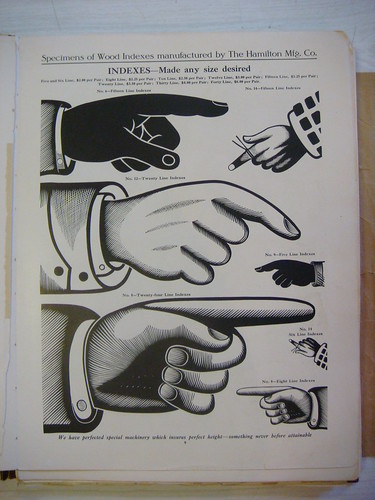
MANICULE.

Reading Leah Price's LRB review of William Sherman's Used Books: Marking Readers in Renaissance England, I hit this sentence: "Sherman puts the digits back in the digital age, arguing that its verbal and visual metaphors derive from the long tradition of hands that mark books and the manicules marked in them." Manicules? It wasn't in the dictionaries, even in the OED (where the letter M was recently revised), so I googled, and discovered this enlightening essay by the very same William Sherman, in which he explains that "the textual hand-with-pointing-finger symbol" has (very oddly) never had an agreed-on name: the book trade has variously used "fist," "hand," "index cut," "director"...

I have now found 15 other names for what I prefer to follow the manuscript specialists in calling the manicule: hand, pointing hand, hand director, pointer, digit, fist, mutton fist, bishop's fist, index, indicationum, indicator, indicule, maniple, and pilcrow. The last three terms are outright mistakes: indicule and maniple are mishearings, misrememberings, or conflations of similar words. ... Pilcrow, finally, properly designates the backwards p symbol used to mark new paragraphs (¶—many of us still use the symbol in editing texts but, again, few of us could recognize or recall the technical term for it). But the rest of the names have all been 'correct' at some point in the history of texts, and most of them can still be found in recent literature. The only way a single name could be established is if librarians can agree upon a standardized terminology for marks like this one and then achieve universal dissemination among their staff and readers...

For my part, I have settled on "manicule" because it seems like the most general and most neutral description of the symbol: it derives from the Latin manicula, simply meaning "little hand," and that really captures what it is without getting into the messy business of what it does. Another thing that "manicule" has going for it is that it applies equally to little hands in all kinds of texts, and to those produced by readers as well as for them, whereas "fist" has its origins in printers' slang and should properly be restricted to the products of the printing press. The biggest problem with "manicule"—aside from the fact that people will keep mixing it up with manciples, manacles, and manicures—is that it is not (yet) an English word. It is apparently the standard term for the symbol in modern romance languages and it is belatedly being imported into English, but it's not yet in the OED or any other dictionary of current usage, and my spell-checker certainly doesn't like it.

I agree with him that it would be very useful to have a single, unambiguous term for the thing (you can see a few samples here), and I hereby urge everyone to start calling it "manicule" and lobby the OED to include it. (Aside from terminological issues, by the way, Sherman's essay is very interesting on the symbol's history and uses.)

Update. Here's a nice set of images—thanks, Nathan!

Posted by languagehat at 08:46 PM | Comments (25)

ATLAS OF TRUE NAMES.

Via a NY Times "Lede" post (thanks, Bonnie!), I learned about the Atlas of True Names:

The Atlas of True Names reveals the etymological roots, or original meanings, of the familiar terms on today's maps of the World and Europe. For instance, where you would normally expect to see the Sahara indicated, the Atlas gives you "Sea of Sand", derived from Arab. es-sahra "desert, sea of sand". The 'True Names' of 1500 cities, countries, rivers, oceans and mountain ranges are displayed on these two fascinating maps, each of which includes a comprehensive index of derivations.

Etymology, (OGr. etymon “true sense” and logos “speech, oration, discourse, word”) is the study of the origin and history of words. For the first time, the Atlas of True Names uses etymology to give us an unusual insight into familiar geographical names – with intriguing results......

The linked webpage shows closeups of a couple of areas of the map, North America and Britain/Ireland, and it looks like a lot of fun: Florida becomes "Blossoming Land," Chicago "Stink Onion," and so on. And when the names are unchanged, like Oakland, you find yourself contemplating the literal meaning of the name for the first time, perhaps, since you were a kid.

Now, it goes without saying that not all the etymologies are cast-iron, and some are pretty dubious ("I Don't Understand You!" for Yucatan); much is made of this in the Language Log post about the map, but this is nitpicking. Anyone who gets seriously interested can find more authoritative references. Furthermore, a couple of commenters there complain that giving deep etymological origins of toponyms derived from other toponyms is misleading: "Even if York means "Wild Boar Village", the people who named New York (a) didn't know, (b) didn't care..." But the idea is not to provide an analysis of the history of the name but to give the earliest available meaning for the name. It's a thought experiment and mind-joggler, not an awe-inspiring work of reference, and for what it is, it seems to be very well done (they provide a list of all the etymologies they used). Intelligent, well-constructed fun is a good thing.

Posted by languagehat at 02:36 PM | Comments (84)

November 22, 2008

TANGO WITH COWS.

For me, the explosion of artistic innovation in Russia in the first two decades of the twentieth century is one of the most underappreciated cultural flowerings in history. The very name by which it is generally known, the "Silver Age," implicitly devalues it by comparison with the "Golden Age" of Pushkin & Co. a century earlier—Omry Ronen wrote an entire book protesting the name, in his conclusion quoting Roman Jakobson as hesitating between the terms "Second Golden Age" and "Platinum Age," either of which would certainly be preferable. (And how I would love to sit in on Prof. Ronen's University of Michigan course Russian 478, "Vladimir Nabokov and World Literature I: The Russian Years"!)

At any rate, you can get a nice taste of one aspect of the period, Russian Futurism, from the exhibition "Tango with Cows: Book Art of the Russian Avant-Garde, 1910–1917"; the site shows sample illustrated books through which you can leaf electronically, and you can even hear the poetry read with enjoyable vigor. The Curator's Essay by Nancy Perloff, Associate Curator of Modern and Contemporary Collections at the Getty Research Institute, provides a brief introduction explaining the origin of the movement and its essential differences from the more famous Italian Futurism, and of course if you're lucky enough to be at the Getty between now and next April 19 you can see the exhibit for yourself.

Addendum. The name of the exhibit comes from the title of a poem by Vasily Kamensky, one of the major Futurists; having discovered he didn't have a Wikipedia entry, I spent most of the day creating one.

Posted by languagehat at 10:38 AM | Comments (37)

November 21, 2008

H. W. BAILEY.

The latest post by the estimable Conrad, along with the ensuing comment thread, prompts me to share with you all the remarkable life of H. W. Bailey. The Wikipedia entry is a good start:

Bailey was born in Devizes, Wiltshire, and raised from age 10 onwards on a farm in western Australia without formal education. While growing up, he learned German, Italian, Spanish, Latin, and Greek from household books, and Russian from a neighbor. After he grew interested in the lettering on tea-chests from India, he acquired a book of Bible selections translated into languages with non-European scripts, including Tamil, Arabic, and Japanese. By the time he had left home, he was reading Avestan as well....

Bailey has been described as one of the greatest Orientalists of the twentieth century. He was said to read more than 50 languages, and was the world's leading expert in Khotanese, the mediaeval Iranian language of the kingdom of Khotan in Chinese Turkestan. He was known for his immensely erudite lectures, and once confessed: "I have talked for ten and a half hours on the problem of one word without approaching the further problem of its meaning." ...

But there is much more detail in the Encyclopaedia Iranica biography and bibliography by John Sheldon:
His parents decided to emigrate to Western Australia and bought 805 acres of virgin bushland about two hundred kilometres east of Perth. Hence it was that Harold Bailey never again attended a school, but worked with the other members of his family to clear the land and turn it into a farm. His spare time was devoted to reading and he devoured everything that he could find starting with the eight volume Harmsworth Encyclopaedia in which he first read about "Teheran" and "Avestan" and four other books containing lessons in French, Latin, German, Greek, Italian and Spanish. In 1919 he seems to have gained access to books in Sanskrit, Pali and Avestan... Bailey's extraordinary ability to remember any word he had seen in any language, which was described by many of the most erudite of his peers in later life as "phenomenal", was without doubt in evidence in his youthful years. The extent of the knowledge he had somehow acquired can be gauged by the fact that he managed during his early time at the university to compose a long Sanskrit poem in the mandākrāntā metre....

During the Oxford years Bailey was at long last able to pursue Oriental Studies at an academic level. His official courses were in Vedic, Classical Sanskrit and Prakrit under F. W. Thomas and James Morrison. He was R. P. Dewhurst's first regular student in Avestan, still called Zend at that time; he did not attend G. E. K. Braunholtz's classes in Comparative Philology, as they were deemed too elementary for him. In addition to this, he attended lectures in Old Irish; throughout his life he maintained a deep interest in all things Celtic. He spent a good deal of time on Armenian, being awarded in 1928 the first Nubar Pasha Armenian Scholarship which he put to good use by working on the Armenian Alexander Romance. In this same year he learnt Georgian by transcribing all one thousand six hundred quatrains of Rustaveli's Man in the Panther Skin from a copy in the Bodleian Library....

During the war the London School of Oriental and African Studies was forced to move to Cambridge and Henning, along with other scholars of German nationality, was interned. Bailey saw to the publication of Henning's book Sogdica, for which he wrote a brief preface, and assisted the War Office's Postal Censorship division with translation of some less familiar languages such as Georgian and Kurdish. Of greater importance was the work he did at the Research Institute of International Affairs housed at Balliol College Oxford and later in London, where at the invitation of Arnold Toynbee he joined the team of experts whose work it was to study foreign language newspapers for information of strategic importance; Bailey's contribution was mainly in Albanian and Armenian, although at the end of the war he continued to give assistance with Russian and Ossetic....

At the same time Ossetic studies received a boost when Bailey convinced the University authorities to engage a native speaker of the less well-known and more archaic Digoron dialect to come to Cambridge as informant. Bailey had a special interest in epic poetry and during the course of his life read most of the major works of this genre in their original languages. At this time he worked on the Ossetic Nart tales. In 1966 he travelled to the Caucasus where he amazed an audience by addressing them in both Ossetic dialects. In the same year he represented the United Kingdom with two others at the eight hundredth anniversary of the great Georgian poet Shota Rustaveli in Tbilisi. On this occasion he was presented with a national costume and sword of which he was very proud. He is to be seen in this garb in the painting of him by Ronald Way which hangs in Queens' College. When the portrait was unveiled in 1972, Bailey was hailed as the College's "greatest scholar since Erasmus" ... Other initiatives of Bailey outside the mainstream of his work included bringing to Cambridge native speakers of Abaza and Tibetan, the former a Caucasian language which interested Bailey because of its unusually large number of consonants including some which at that time were being postulated for Proto-Indoeuropean.

As Bailey had experienced little formal teaching during his own apprentice years, it is not surprising that he had little idea of teaching methods or the needs of an undergraduate coming to the study of a language at an elementary level. ... The lectures bore a marked similarity to his written work and chiefly consisted of studies of the etymologies of individual words. Thus, starting from a line of the Veda, he would give the root of a word and proceed to discuss its connections; he would linger on Iranian cognates often bringing his recent Khotanese discoveries into the discussion. Bailey prepared his lectures with care and they were mostly held in his set of rooms in Queens' College, already so filled with books, journals and manuscripts that there was barely room to move. ... Bailey always treated his students, even the less capable ones, with great courtesy and displayed disarming modesty in assuming that they would always follow his arguments, often adding, 'as you know' to re-assure them. He liked to have his students and friends to tea and would always provide a freshly baked cake which he would cut up and serve while conversing about his current work....

After he ceased work on Khotanese, he devoted much of his remaining time to studying Iranian loanwords in Caucasian languages and went back to revise his 1933 edition of the Pahlavi Greater Bundahišn . This was finished in 1989. Unfortunately by this time his eyesight had deteriorated to the point that he needed large magnifying apparatus to work and his handwriting was becoming almost impossible to read. In the only copy of his text, which was intended for photographic reproduction, he tried to insert the many words in Pahlavi script in his own hand thereby rendering it illegible. For this reason it has never been published. As it became increasingly difficult for him to commit his unabated flow of thoughts to paper, his frustration was to some extent alleviated by the presence of scholars working and visiting at Brooklands House; at least he was able to talk about his ideas. He maintained his independence until close to the end of his life despite the worsening of his vision and hearing. To the end, however, physical deterioration did not impair his intellectual activity. Robert Coleman in his speech at Bailey's funeral describes a visit he paid to his former teacher in Addenbrooke's Hospital a few days before his death, during which the old man "suddenly launched into a fifteen-minute exposition of some new etymologies that had occurred to him", concluding with his last recorded words, "'I think I shall write this up when I come out; it should make a small monograph'."

I stand in awe of this man; the energy and determination involved in composing a long Sanskrit poem or learning Georgian by transcribing the entire Man in the Panther Skin are almost incredible, let alone learning all those languages, investigating their historical relationships, and promoting their study. And you could mine the material for several novels out of his life; Henry James could have made a brilliant novelette just out of the incident of his rendering his long-simmered Pahlavi edition unpublishable by trying to improve it. Here's to you, H.W.; if there's an afterlife, I hope you're learning its languages and teaching it both dialects of Ossetian.

Posted by languagehat at 02:59 PM | Comments (13)

November 20, 2008

SORITES.

Reading David Runciman's essay "Why Not Eat an Eclair?" in the 9 October 2008 LRB (it's about why people vote despite the fact that their individual vote will not count), I hit this passage (which, among other things, explains the title):

Tuck’s threshold argument is compelling but it skirts around a significant fact about real-world elections that I highlighted earlier: although in theory it only requires one vote to take someone over the top, in practice, the closer you get to that threshold the harder it is to find it, as the mist of political enmity descends. One way to address this is provided by Tuck’s account of other cases where the threshold seems to disappear the closer you get to it. This happens when the borderline between two states of affairs is unavoidably vague, even though the process of change is cumulative. Baldness is a classic example. I go bald by losing my hair one strand at a time, but the loss of no one strand is enough in itself to move me from the category of non-bald to bald. So if I consider the loss of my hair on a strand by strand basis, I can’t go bald, not even if I lose it all. The same kind of reasoning can also apply the other way, say to fatness. No single éclair is ever going to make me fat, so I might as well eat this one. But if no single éclair will ever make me fat then, having eaten one yesterday, I might as well eat another one today, and so on, until I become the thing that one éclair at a time isn’t supposed to make me: fat. These are known as ‘sorites’ paradoxes (the ‘sorites’ being a ‘heap’ of the kind that ought never to arise if you add to it one grain of wheat at a time). It is not easy to say how they should be resolved. But Tuck shows that the best way to think about these puzzles is to consider them as not that different from the problem of voting.
All of this stuff is interesting, but what struck me from a linguistic point of view is the use of the word sorites. It is indeed from Greek σωρείτης 'fallacy of the heap' (from σωρός 'heap'; in English it's pronounced suh-RITE-eze, and despite appearances, it's singular), but according to Merriam-Webster, it means "an argument consisting of propositions so arranged that the predicate of any one forms the subject of the next and the conclusion unites the subject of the first proposition with the predicate of the last"—a very different thing. The OED agrees, but has a sense 3 "A sophistical argument turning on the definition of a ‘heap’," which has one citation, from 1768-74: Abraham Tucker, The light of nature pursued II. 140 "The like attack as was made of old by the Academics and Sceptics against the judgment of the senses, with their sophism of the sorites, or argument of the ‘heap’."

So my question to those who actually know and use the word is: does that third OED sense, with its lonely centuries-old quotation for support, represent a current sense that will have more citations when they get around to revising the entry, or is Runciman misrepresenting current usage?

Posted by languagehat at 05:58 PM | Comments (74)

November 19, 2008

JAPANESE WORDS OF 2008.

I can't believe I'm scooping No-sword on this, but Top 60 popular Japanese words/phrases of 2008 (at Pink Tentacle, translated from a list from publishing company Jiyu Kokuminsha, from which "a panel of judges will select the trendiest Japanese word of 2008") is a most interesting look into contemporary Japanese culture and language. There's everything from baseball:

30. Make Legend (meiku rejendo - メーク・レジェンド): This is the slogan of the 2008 Yomiuri Giants baseball team under manager Tatsunori Hara, who beat the odds to win the 2008 Central League Championship. The slogan is reminiscent of the team’s 1996 slogan of “Make Drama” (which, in hybridized Japanese-English, means to achieve success after a dramatic turnaround). That season, the Giants under manager Nagashima captured the Central League pennant and “Make Drama” was recognized as the trendiest expression of 1996.
to politics, economics, and history; there is also, of course, pop culture, though not as much as one might have expected, and the occasional note about pure language use ("Choriiissu (チョリ~ッス): Shibuya slang for 'hello'"). Via MetaFilter.

Posted by languagehat at 11:27 AM | Comments (7)

November 18, 2008

ZUKOFSKY AT PENNSOUND.

PennSound has put together a wonderful resource for fans of Louis Zukofsky:

Nearly six months in the making, this page brings together nearly twenty full-length recordings by the poet, including important readings, conversations and lectures, along with supplementary materials responding to Zukofsky's work.

The earliest of the seventeen readings contained in our Zukofsky archives is a 1954 appearance on Berkeley's KPFA Radio, which includes a number of excerpts from 1946's Anew, as well as "A"-11 and the second half of "A"-9. Selections from Anew and 1941's 55 Poems comprise much of the setlist from his 1958 reading at the Poetry Center at the San Francisco State University...

They continue up through "a 1975 recording by Hugh Kenner of a reading at Johns Hopkins University featuring selections from "A" and 80 Flowers, plus 'A Foin Lass Bodders,' Zukofsky's Brooklynese rendering of Cavalcanti's 'Donna Me Prega'"; there's also "a 1961 conversation between Zukofsky and Robert Creeley, a 1971 lecture on Wallace Stevens at the University of Connecticut," and "a number of recordings of contemporary poets performing and interpreting Zukofsky's work," as well as some videos. What a treasure!

Mind you, we're not talking about a Dylan Thomas reading. If you're not already a Zukofsky fan, hearing him read his poems will probably not convert you. But if you're already attuned to the subtle music of his wonderfully constructed verse, it's endlessly fascinating to hear it realized with that Brooklyn voice overlaid with a strange suggestion of a British accent.

Posted by languagehat at 08:27 PM | Comments (6)

November 17, 2008

SUBJECTA BELLIGERANTIA.

I'm almost finished reading Wedgwood's The Thirty Years War (discussed here), and in discussing the painfully slow process that eventually led to the Peace of Westphalia she says (on page 462 of my edition) "The congress had been sitting for nearly a year when the delegates found that they were still in doubt as to the subjecta belligerantia." The phrase in italics clearly meant something like "the subjects of the war" or "the reasons everyone was fighting," but it wasn't in my reasonably comprehensive Dictionary of Foreign Words and Phrases, so I googled it... and, to my astonishment, got exactly one hit: to this very book. I tried Google Book Search and got a few more hits, all of them in German and all of them, so far as I can tell (from the gottverdammt Auszug [snippet] view), referring to this very peace congress. Is it not odd that this reasonably normal-looking Latin phrase should occur only in this one context?

Posted by languagehat at 05:32 PM | Comments (124)

November 16, 2008

THE BOOKSHELF: LIMITS OF LANGUAGE.

Over a month ago, I got a review copy of Mikael Parkvall's Limits of Language: Almost Everything You Didn't Know You Didn't Know About Language and Languages and almost immediately fell in love with it. I kept meaning to write about it, but every time I looked into it I discovered more goodies and thought "I'll live with it some more before I do the post." Now, prodded by an e-mail from C. Max Magee of The Millions reminding me that it was time to submit an essay for his annual "A Year in Reading" series (here's my entry from last year), I realize that it's high time I got around to it, so I'm just going to grab examples at random and assure you there's much, much more where that came from.

Parkvall, a Swedish linguist, says in the foreword: "I hope that Limits of Language can show the uninitiated some of the incredible aspects that linguistics and human languages have to offer, teach beginners some of the basics of linguistics, but also to serve as a reference book for experienced linguists—here, the linguist can identify the extremes, and thereby judge to what extent his or her own language is 'normal'." (This last clause explains the title; I must admit I was disappointed that it was not from the Godard/Wittgenstein quote cited in this post, but you can't have everything.) You can see the table of contents at the end of this LINGUIST List post; it includes things like "Language as a legal matter," "Language in alternate history," and "Classic example sentences" as well as basics like "Language change," "Consonants," and—close to my heart—"Language myths" (which starts with a subject dear to Geoff Pullum's heart: "The legendary snow hoax"). But you can't predict what's going to be included in a section; under "Language change" we find "Bizarre sound change" ("Examples include */w/ → /q/, */j/ → /q/, */V/ → /ŋgV/, and even */s/ → /k/ before /e/ and /i/"), under "Place names" there's a two-page discussion of American toponyms like Calnevari (California + Nevada + Arizona), and under "Written language" are "Frequent alphabet changes" and "Chromatographic writing" (a script used by the Edo of Nigeria in which "the color of the ovals is distinctive"). Wherever you open the book, you find some fascinating nugget like "An odd geolinguistic situation":

The tiny Caribbean island of Saint-Barthélemy, or St. Barth, presents a remarkable linguistic fragmentation. Despite being a mere 10 kilometers across, and home to little more than 3 000 people, it has traditionally had at least four distinct languages. In the north-western part, a Norman patois has some 500-700 speakers, and in the east, a French-lexicon creole is used by 600-800 people. In the middle region, an archaic variety of French is now on the verge of extinction. In addition to this, in the administrative center of Gustavia, a black population, some 100 strong, speaks a local and slightly creolized variety of English. On top of this, standard French is the official language, and is increasingly used.... Understandably, this diversity requires isolation, and as late as in the 1940s, there were people in the northwestern village of Flamands who only visited Gustavia once a year. And yet, the distance between the two is about two kilometers.
(And there's a map!) Under "Miscellaneous" on p. 375, after a brief explanation of Shaw's "ghoti" = "fish," we learn "Mark Okrand also included this as a deliberate pun in his creation Klingon (pp 157-158). The Klingon word for 'fish' is ghothI." At the end there's an extensive "Linguist's Calendar" (on November 16 in 1974, "A puzzle for future Alien linguists to solve, a message containing information on mankind and the planet we inhabit is broadcast to the M13 star cluster, 50 000 light-years from us") and a 15-page bibliography in small type. It's fun to leaf through, and if you're interested in pursuing a subject further, they point you in the right direction. What more could you ask?

Geoff Pullum wrote about the U.K. edition a couple of years ago, calling it "the ideal birthday present for the linguist in your life who you feel already has everything." It would also, of course, be the ideal Christmas present for anyone who loves language and prefers facts to fancy.

Posted by languagehat at 09:27 PM | Comments (16)

November 15, 2008

MEXICAN SLANG.

Via a comment by vacapinta in this AskMetaFilter thread (well worth reading in its own right), I found Yuri's blog Effective Swearing in D.F. ("Towards a Manual of Communication for English Speakers visiting Mexico City"), a continuing examination of how chilangos (inhabitants of Mexico City) have fun with their marvelously expressive variety of Spanish. Here, pretty much at random, is the post "Johny, Miguel, Tiburcio...":

Chilangos like to avoid lame, merely descriptive sentences. Every time they can they throw some colorful term to surprise and amuse the listener. Instead of using boring pronouns as yo, tú, mi, ti, Chilangos use Johny, tunas, Miguel, Tiburcio. The substitutions are immaterial in terms of meaning. They are purely ornamental. Here are some examples:

yo (I) => Johny
tu (You) => tunas
mi (me) => Miguel
ti (you) => tinieblas, tiburcio, tiburón
acá (here) => Acámbaro, Michoacán
pa'llá (contraction of para allá, over there) => payaso

He gives examples like "¿Quién se chupó mi Viña Real?" [Who drank my wine cooler?] "Johny" [I did], and "¡Hazte payaso!" [Move over!, lit. 'Become a clown!']. And this post not only describes the difference between nacos and fresas, it provides a hilarious video showing the two stereotypes talking with exaggerated stereotypicality. May a thousand such blogs bloom!

Posted by languagehat at 10:03 AM | Comments (37)

November 14, 2008

CLICK SONG.

If you've ever wondered how click consonants sound in practice, the wonderful and recently deceased Miriam Makeba provides a demonstration in her song "Qongqothwane," usually known in English as "The Click Song": YouTube (Dutch TV, September 1979). Thanks, Yoram!

Posted by languagehat at 07:33 PM | Comments (19)

November 13, 2008

PSYCHOPATH.

Reading this New Yorker piece by John Seabrook, I hit the sentence "The word 'psychopath' (literally, 'suffering soul') was coined in Germany in the eighteen-eighties" and of course turned immediately to the OED, where I found that the entry had been revised as recently as September of last year. It says "after PSYCHOPATHIC adj., PSYCHOPATHY n. Compare Russian psixopat (1888 or earlier), French psychopathe (1894), German Psychopath (1898 or earlier)." I was naturally interested to see the earliest attested form was Russian, and a little googling got me this Russian webpage ("Диссоциальное расстройство личности"), which says "по данным О. В. Кербикова (1955) в России термин «психопат» был впервые употреблен И. М. Балинским в 1884 г. во время выступления в суде по делу некоей Семеновой" [according to O. V. Kerbikov (1955), in Russia the term psikhopat was first used by I. M. Balinsky in 1884 in his appearance in court in the case of one Semenova]. The first OED cite supports Balinsky's priority: 1885 Pall Mall Gaz. 21 Jan. 3/2 "For the benefit of those who are as yet ignorant of the meaning of psychopathy.. we give M. Balinsky's [sc. a Russian psychiatrist] explanation of the new malady. 'The psychopath.. is a type which has only recently come under the notice of medical science... Beside his own person and his own interests, nothing is sacred to the psychopath.'" It would be nice to have an exact cite for Balinsky's original use; at any rate, Seabrook seems to be incorrect in claiming it was coined in Germany. The terms it was based on, however—psychopathic and psychopathy—are in fact of German origin (psychopathisch dates back to 1845).

Update. In this thread, LH reader hilding very kindly provided the text of Balinsky's statement: "Психопат тип, лишь недавно установленный в медицинской науке." Now if only we could find an earlier cite!

Posted by languagehat at 01:46 PM | Comments (35)

November 12, 2008

OGGIN(S).

My brother sent me a link to this NY Times story by C. J. Chivers about an American, Isaiah (Cy) Oggins, who became a spy for Stalin and was murdered in a Soviet prison camp. (The author mentioned in the story, Andrew Meier, wrote an excellent book on Russia, Black Earth, and I'd like to read his book on Oggins sometime.) My first question was "What kind of name is Oggins?"; since according to this NPR story he was born to Lithuanian immigrant parents, it's presumably a Lithuanian name (Agins? Ogins? anybody know?).

But in one of those lexicographical detours I so often find myself on, I came across an odd nautical slang word for 'the sea,' oggin, that's only attested from 1945; the OED says "Origin uncertain; perhaps variant of NOGGIN n. with metanalysis (see N n.). Compare DRINK n. 6." Noggin was originally "A small drinking vessel" and came to mean "A small quantity or measure of alcoholic liquor" (first attested 1690; the modern slang sense "The head" dates back to 1769: Stratford Jubilee II. i. 28 "Giving him a stouter on the noggin, I laid him as flat as a flaunder"). The comparison to drink (as in "into the drink") is reasonable. As for the metanalysis, here's the relevant section of the N entry:

From the beginning of the Middle English period, the coexistence of two forms of the indefinite article (an before vowels and a before consonants) often led to metanalysis (the same phenomenon occurs in other languages where the indefinite article ends in -n, e.g. French, Italian, etc.). Variants arising by metanalysis sometimes alliterate with words with initial n- in alliterative verse, and in some cases have become established as the regular modern forms (so that e.g. Middle English a nadder became an adder; compare also apron, auger, etc.), while conversely some vowel-initial forms have gained n- (so that e.g. Middle English an ewt became a newt; compare also nickname).
Thanks, Eric!

Posted by languagehat at 07:34 PM | Comments (21)

November 11, 2008

AMATEUR LINGUISTICS.

Andrey Zaliznyak, a Russian historical linguist, gave a talk last month "On professional and amateur linguistics" that can be read (in Russian) here (found via Anatoly). I recommend it to anyone who can read Russian; for those who can't, I'll translate an excerpt of general applicability:

In school they teach the spelling and grammar of one's native language and elements of foreign ones, but they don't give even a basic idea of how languages change over time. As a result, to satisfy their lively interest in questions related to language, most people must content themselves with whatever information they happen to read or encounter on radio and television. But many try to get answers to these questions by means of their own thoughts and guesses. The fact that they have mastered their own language gives them the feeling that they already possess everything they need to understand the subject, and they only need to think a little in order to get correct answers. In just such a way arises what can be called amateur linguistics.

It must be admitted that part of the blame for the situation lies with the linguists themselves, who take little trouble about the popularization of their science...

In discussing one folk etymology (relating помада [pomada] 'pomade' to the verb мазать [mazat'] 'to grease, smear, anoint'), he makes the point that when confronted with the true etymology (the word is borrowed from French), available in Vasmer's etymological dictionary, people are likely to say "So what? Vasmer has one hypothesis, and here's another; why is it any worse?" That inability to see what makes one explanation better than another is a basic problem here as well as in Russia.

He gives an interesting example of a kind of nonsense that is apparently widespread in Russia: some people claim that "not only did Moscow exist before Rome [which is Rim in Russian], but it was by Moscow's command that the Etruscans built the city and named it Mir ['peace,' 'commune,' 'world'] in the spirit of Russian tradition. Since Etruscans read in the reverse direction, it was read as Rim. In this city, built by the Etruscans, for whom Russian was their native language and Etruscan was a kind of soldiers' jargon, Russian was heard for a long time. Only much later, when Latins moved to Rome, did they distort it according to their own phonetics and grammar."

Posted by languagehat at 04:19 PM | Comments (18)

November 10, 2008

AND NOW: NAUI!

A most enjoyable little article at Néojaponisme, by Matt Treyvaud of No-sword, discusses the short, inglorious career of the Japanese "dead word" naui 'now-y,' "a mayfly of a word, declared dead almost as soon as it was born [in 1979], reviled as a desperate attempt to squeeze a few more youth dollars out of an already-uncool borrowed English lexeme ('now')":

Back then, naui wasn’t without competition. For example, imai 「今い」, was a roughly contemporaneous and structurally identical synonym based on the Japanese word for “now” instead of the English one. But naui bested all contenders on sheer charisma. The precise image it invokes of an awkward middle-aged man finger-quote “rapping” with the finger-quote “kids” kept it in the vocabulary of both middle-aged men oblivious to their own awkwardness and all those embarrassed by and for same.
One interesting bit is a casual name-check of Cartaphilus, one of the versions of the Wandering Jew—to quote the Wikipedia entry, "a Jewish shoemaker, who, when Jesus stopped for a second to rest while carrying his cross, hit him, and told him 'Go on quicker, Jesus! Go on quicker! Why dost Thou loiter?', to which Jesus, 'with a stern countenance,' is said to have replied: 'I shall stand and rest, but thou shalt go on till the last day.'" A more familiar name is Ahasver or Ahasuerus (under which name the Russian Wikipedia, as well as some other Slavic languages, places the story).

Posted by languagehat at 07:44 PM | Comments (29)

November 09, 2008

FRY ON LANGUAGE.

Some of you may remember a post from last year in which I marveled at the Fry and Laurie sketch Language Conversation; I am happy to report that Stephen Fry, in his new blog, has a post called "Don’t Mind Your Language…" in which he deals seriously (well, as serious as Fry ever gets, which is serious wrapped in a delicious coating of good humor and brilliant wit) with the same topic. It is a long post and I urge you to consume every morsel of it; here I will excerpt a passage that, for reasons obvious to anyone who has spent any time here, gave me particular delight:

Sadly, desperately sadly, the only people who seem to bother with language in public today bother with it in quite the wrong way. They write letters to broadcasters and newspapers in which they are rude and haughty about other people’s usage and in which they show off their own superior ‘knowledge’ of how language should be. I hate that, and I particularly hate the fact that so many of these pedants assume that I’m on their side. When asked to join in a “let’s persuade this supermarket chain to get rid of their ‘five items or less’ sign” I never join in. Yes, I am aware of the technical distinction between ‘less’ and ‘fewer’, and between ‘uninterested’ and ‘disinterested’ and ‘infer’ and ‘imply’, but none of these are of importance to me. ‘None of these are of importance,’ I wrote there, you’ll notice – the old pedantic me would have insisted on “none of them is of importance”. Well I’m glad to say I’ve outgrown that silly approach to language. ...

There are all kinds of pedants around with more time to read and imitate Lynne Truss and John Humphrys than to write poems, love-letters, novels and stories it seems. They whip out their Sharpies and take away and add apostrophes from public signs, shake their heads at prepositions which end sentences and mutter at split infinitives and misspellings, but do they bubble and froth and slobber and cream with joy at language? Do they ever let the tripping of the tips of their tongues against the tops of their teeth transport them to giddy euphoric bliss? Do they ever yoke impossible words together for the sound-sex of it? Do they use language to seduce, charm, excite, please, affirm and tickle those they talk to? Do they? I doubt it. They’re too farting busy sneering at a greengrocer’s less than perfect use of the apostrophe. Well sod them to Hades. They think they’re guardians of language. They’re no more guardians of language than the Kennel Club is the guardian of dogkind.

The worst of this sorry bunch of semi-educated losers are those who seem to glory in being irritated by nouns becoming verbs. How dense and deaf to language development do you have to be? If you don’t like nouns becoming verbs, then for heaven’s sake avoid Shakespeare who made a doing-word out of a thing-word every chance he got. He TABLED the motion and CHAIRED the meeting in which nouns were made verbs. New examples from our time might take some getting used to: ‘He actioned it that day’ for instance might strike some as a verbing too far, but we have been sanctioning, envisioning, propositioning and stationing for a long time, so why not ‘action’? ‘Because it’s ugly,’ whinge the pedants. It’s only ugly because it’s new and you don’t like it. Ugly in the way Picasso, Stravinsky and Eliot were once thought ugly and before them Monet, Mahler and Baudelaire. Pedants will also claim, with what I am sure is eye-popping insincerity and shameless disingenuousness, that their fight is only for ‘clarity’. This is all very well, but there is no doubt what ‘Five items or less’ means, just as only a dolt can’t tell from the context and from the age and education of the speaker, whether ‘disinterested’ is used in the ‘proper’ sense of non-partisan, or in the ‘improper’ sense of uninterested. No, the claim to be defending language for the sake of clarity almost never, ever holds water. Nor does the idea that following grammatical rules in language demonstrates clarity of thought and intelligence of mind.

"It’s only ugly because it’s new and you don’t like it": exactly. That's a fine summary of everything I've tried to say about language prejudice in this blog.

I do have a minor quibble about his example of semantic change that not even the most barnacle-encrusted pedant could object to: "I don’t mind either that the word ‘meld’ is now being used as a kind of fusion of melt and weld, instead of in its original sense of ‘announce’. Meld has changed … that’s okay. There’s no right or wrong in language, any more than there’s right or wrong in nature." The sentiment is unimpeachable, but meld has not changed in meaning; rather, there is a very old verb meld "To make known (by speech), reveal, declare" (related to German melden 'to report'), which went out of use 600 years ago, and a very new verb meld "To merge, blend; to combine or incorporate"—probably, as Fry says, a fusion of melt and weld—that first appears in 1936 (D. T. Lutes, Country Kitchen xi. 234 "Apple, currant, and raisin all melded into one sweetly tart aroma"). I like to use bead for this purpose, with its dramatic transition in sense from 'prayer' to 'little round thing.'

But never mind that; I enthusiastically second his eloquent peroration: "If you are the kind of person who insists on this and that ‘correct use’ I hope I can convince you to abandon your pedantry. Dive into the open flowing waters and leave the stagnant canals be."

Thanks for the link, Paul!

Posted by languagehat at 11:46 AM | Comments (71)

November 08, 2008

TAGALOG AND TAGLISH.

A very interesting post at A Small Gleaning Factory ("notes + observations in the style and spirit of bouvard & pecuchet") is called "Birth of Taglish, or Why Niknok Spoke That Way." The intro will explain the title:

Reading the passage below made me understand the phenomenon of Taglish, or the admixture of Tagalog and English. When I was in grade school, we would rush to the school library every week to read the latest Niknok komiks. Niknok, who I guess is kind of a Denise the Menace or Bart Simpson-like character, constantly found himself in trouble with his elders and with his use of Taglish. I remember educators being upset by the example Niknok supposedly held for us youngsters. Of course, this 'problem' had a different inflection for us in the Visayan region where we spoke the Cebuano vernacular. Instead we were reprimanded for speaking dialect in class, a vernacular that I was slowly learning.
The rest of the post is a long excerpt from Vicente Rafael's White Love and Other Events in Filipino History (Duke UP, 2000); here's a paragraph to whet your appetite:

Accordingly, Tagalog was designated as the basis of the yet-to-be instituted national language (wikang pambansa) by the Commonwealth government in 1938 and again by the Japanese occupation regime in 1943. But objections by non-Tagalog speakers in the national legislature during the postwar period resulted in a series of name changes. The Philippine legislature renamed the putative national language "Pilipino" to stress the national vocation of Tagalog. In 1973, however, the constitutional convention held under the martial law regime of Ferdinand Marcos changed this name yet again, to "Filipino," while admitting that it was merely designating a Manila-based lingua franca that was still far from having a truly national currency. The constitution of 1986 upheld this term to designate not so much the national language as what the national language might be called should it ever emerge. Filipino continues to be based on Tagalog with greater infusions of English and bits of Spanish rather than, as nationalist linguists had proposed as early as 1915, a fusion of all the different Philippine vernaculars. As the linguist Andrew Gonzalez has noted, "One must class the Philippines as among those nations thus far without a national language although with a non-local common language as an official code with which to conduct [official] transactions." In effect, there continues to be a lack of fit between the officially designated national language and officially conceived borders of the nation-state.
The excerpt ends: "As the lingua franca of the mass media, Tagalog manages in fact to have a translocal reach. It does so, however, only and always in conjunction with other translocal languages: English and Spanish. Thus, it is as another kind of language, Taglish, that Tagalog comes across as a lingua franca, providing the conditions for the emergence of a mass audience in the contemporary Philippines." Thanks for the link, Trevor!
Posted by languagehat at 04:34 PM | Comments (5)

November 07, 2008

PALATIA GERMANORUM.

I've been reading C. V. Wedgwood's classic history The Thirty Years War in an attempt to understand a very messy period of European history, and am finally, among many other things, getting a handle on who was Calvinist and who was Lutheran and why so many Catholic powers (including the Pope) opposed the ultra-Catholic Habsburgs. Wedgwood is one of those gifted storytellers who can lead the reader on a reasonably clear path through a dark forest, in this case the mind-boggling complexity of the Holy Roman Empire—quite literally, in the way she shows how the position of the Palatinate athwart the route the Habsburgs needed to take to resupply their troops in the Spanish Netherlands made it central to events at the beginning of the war.

But I'm not here to talk about the war ("Don't mention the war!"), I want to discuss the many German words descended from Latin palātium 'palace' (originally the Palatine Hill). I vaguely knew that the Count or Elector Palatine (an older equivalent is palsgrave), the ruler of the Palatinate, was so called (in the OED's words) "as exercising the sovereign's authority in certain matters, or as having a jurisdiction within a given territory such as elsewhere belongs to the sovereign alone," and I knew that the German equivalent of Palatinate was Pfalz; what I didn't know was that Pfalz is also an old term for a palace, which makes perfect sense given its etymology (MHG pfalz(e), pfallaz, phal(e)nze, OHG phalanza, phalnze, from post-classical Latin palantia, an alteration of palatia, a feminine singular arising from reinterpretation of the plural of classical Latin palātium). Knowing that the normal word for 'palace' is Palast, I looked that up in my trusty Lutz Mackensen and discovered that the -t is secondary; the earlier form Palas is still in use for some sort of lordly building (there's no English Wikipedia entry, and it's not in my unabridged German-English dictionary, so I don't know how to translate it). Furthermore, there's a borrowing from French of the same word, Palais. That seems like more descendants of palātium than any language really needs.

Posted by languagehat at 04:32 PM | Comments (46)

November 06, 2008

GOTHIC YIDDISH?

Charles Nydorf has a blog proposing that Yiddish began as a form of the Gothic language:

Contact with an older form of Yiddish, got me back to thinking about the origins of the language and its relations to other members of the Germanic family. I remembered an observation of Professor Robert Austerlitz that although Yiddish was quite different from German, it was typologically very much a Germanic language. Perhaps, I thought, its origin lay not in a German dialect but in another Germanic language. I starting looking at other Germanic languages with which the early Ashkenazim could have come into contact in Europe. The first possibility I looked at was Old Scandinavian which was spoken by Varangian settlers in Ukraine between about 800 and 1000. The match was not particularly good and I turned to the East Germanic languages, known through Gothic, that were spoken in eastern Europe between about 1 CE and 700. Gothic proved to be a surprisingly good typological match with Yiddish and I eventually concluded that the earliest Yiddish took a Gothic form.
Here's his post on "The Gothic Background of Yiddish." I don't know nearly enough to begin to evaluate this proposal, but as far as I know, the standard history of Yiddish puts its origin on the other side of the German-speaking world, in the Rhine region. Does anybody have any informed thoughts about this? (Thanks for the link, rootlesscosmo!)

Posted by languagehat at 05:04 PM | Comments (55)

CZECHIA.

When I read this post by Joel of Far Outliers, I felt a lightbulb go off in my head:

Last weekend, I also had the opportunity to meet a scholar visiting from the Czech Republic, who repeatedly referred to her nation as Czechia—a most sensible formulation which I subsequently found to have had official sanction since 1993 (along with Česko, the Czech equivalent), but which seems to be very slow to spread among English speakers, who perhaps still feel guilty about agreeing to carve up Czechoslovakia in 1938 and want to compensate by resisting any attempt to shorten the fuller form of its current name. However, feeling no guilt on that score despite my English heritage, I henceforth resolve to refer to that glorious center of historic dissidence as Czechia, plain and simple. In fact, I've just added Czechia to my list of country categories for this blog. I had already added Bohemia before, but that does no justice to Moravia, which has, if anything, an even greater tradition of religious dissidence.
Sure enough, the Czech Republic Country Guide says: "Czechia is the official one-word name of the Czech Republic. In 1993 the Ministry of Foreign Affairs of the Czech Republic in its memorandum to to all Czech embassies and diplomatic missions recommended to use the full name 'Czech Republic' only in official documents and titles of official institutions." I have often lamented the absence of a simple term like "Czechia" in English, but never realized that I could be helping to spread it and save people the trouble of constantly repeating "the Czech Republic." I hereby join Joel in his resolve.

Posted by languagehat at 12:52 PM | Comments (80)

November 05, 2008

AMERICA AGAIN.

Let America Be America Again

by Langston Hughes

Let America be America again.
Let it be the dream it used to be.
Let it be the pioneer on the plain
Seeking a home where he himself is free.

(America never was America to me.)

Let America be the dream the dreamers dreamed—
Let it be that great strong land of love
Where never kings connive nor tyrants scheme
That any man be crushed by one above.

(It never was America to me.)

O, let my land be a land where Liberty
Is crowned with no false patriotic wreath,
But opportunity is real, and life is free,
Equality is in the air we breathe.

(There's never been equality for me,
Nor freedom in this "homeland of the free.")

Say, who are you that mumbles in the dark?
And who are you that draws your veil across the stars?

I am the poor white, fooled and pushed apart,
I am the Negro bearing slavery's scars.
I am the red man driven from the land,
I am the immigrant clutching the hope I seek—
And finding only the same old stupid plan
Of dog eat dog, of mighty crush the weak.

I am the young man, full of strength and hope,
Tangled in that ancient endless chain
Of profit, power, gain, of grab the land!
Of grab the gold! Of grab the ways of satisfying need!
Of work the men! Of take the pay!
Of owning everything for one's own greed!

I am the farmer, bondsman to the soil.
I am the worker sold to the machine.
I am the Negro, servant to you all.
I am the people, humble, hungry, mean—
Hungry yet today despite the dream.
Beaten yet today—O, Pioneers!
I am the man who never got ahead,
The poorest worker bartered through the years.

Yet I'm the one who dreamt our basic dream
In the Old World while still a serf of kings,
Who dreamt a dream so strong, so brave, so true,
That even yet its mighty daring sings
In every brick and stone, in every furrow turned
That's made America the land it has become.
O, I'm the man who sailed those early seas
In search of what I meant to be my home—
For I'm the one who left dark Ireland's shore,
And Poland's plain, and England's grassy lea,
And torn from Black Africa's strand I came
To build a "homeland of the free."

The free?

Who said the free? Not me?
Surely not me? The millions on relief today?
The millions shot down when we strike?
The millions who have nothing for our pay?
For all the dreams we've dreamed
And all the songs we've sung
And all the hopes we've held
And all the flags we've hung,
The millions who have nothing for our pay—
Except the dream that's almost dead today.

O, let America be America again—
The land that never has been yet—
And yet must be—the land where every man is free.
The land that's mine—the poor man's, Indian's, Negro's, ME—
Who made America,
Whose sweat and blood, whose faith and pain,
Whose hand at the foundry, whose plow in the rain,
Must bring back our mighty dream again.

Sure, call me any ugly name you choose—
The steel of freedom does not stain.
From those who live like leeches on the people's lives,
We must take back our land again,
America!

O, yes,
I say it plain,
America never was America to me,
And yet I swear this oath—
America will be!

Out of the rack and ruin of our gangster death,
The rape and rot of graft, and stealth, and lies,
We, the people, must redeem
The land, the mines, the plants, the rivers.
The mountains and the endless plain—
All, all the stretch of these great green states—
And make America again!

Posted by languagehat at 08:57 AM | Comments (57)

November 04, 2008

STUDS TERKEL.

I didn't post about the passing of Studs Terkel, one of my few remaining heroes, because it didn't seem to have any relation to the ambit of LH, but I am pleased to find, via Arnold Zwicky at the Log, that I am wrong: his writings were a great resource for linguists.

Studs Terkel, who died recently, at the age of 96, had a special place in the hearts of some linguists — those who were studying the syntax (and accompanying pragmatics) of colloquial Englsh, back in the old days, before very large corpora and automated search techniques were easily available.

There were essentially two says to investigate colloquial language non-anecdotally: collect your own corpora... or use other people's corpora, collected for other purposes... Collecting your own corpora is hard work... Piggy-backing on other people's corpora hugely simplifies the task.

That's where Studs Terkel comes in. He spent decades interviewing (mostly) ordinary people and publishing the conversations, and he was fantastic at establishing a rapport with the folks he interviewed. The result was a body of corpora that's a goldmine of data for (some) linguists, from Division Street (1966) on....

In the old days, you still had to search through the texts by hand, mark all the relevant examples, code them, put them on index cards (so that they could later be sorted and counted on your living-room floor, or its equivalent); it helps a lot if the stuff you're reading actually has some interest for you. ... Studs's books were a big help.

So thanks, Studs, not only for being a mensch and giving public voice to the hitherto voiceless, but for helping linguists do their work. You'll be missed by even more people than I realized.

Posted by languagehat at 10:55 AM | Comments (17)

November 02, 2008

BANNING LATIN.

My initial thought was that this Telegraph story must be a joke, but since it quoted a bunch of real people and the date wasn't the first of April, I reluctantly concluded it must be factual:

Local authorities have ordered employees to stop using the words and phrases on documents and when communicating with members of the public and to rely on wordier alternatives instead.

The ban has infuriated classical scholars who say it is diluting the world's richest language and is the "linguistic equivalent of ethnic cleansing".

Bournemouth Council, which has the Latin motto Pulchritudo et Salubritas, meaning beauty and health, has listed 19 terms it no longer considers acceptable for use.

This includes bona fide, eg (exempli gratia), prima facie, ad lib or ad libitum, etc or et cetera, ie or id est, inter alia, NB or nota bene, per, per se, pro rata, quid pro quo, vis-a-vis, vice versa and even via.

Its list of more verbose alternatives, includes "for this special purpose", in place of ad hoc and "existing condition" or "state of things", instead of status quo.

In instructions to staff, the council said: "Not everyone knows Latin. Many readers do not have English as their first language so using Latin can be particularly difficult."

The details of banned words have emerged in documents obtained from councils by the Sunday Telegraph under The Freedom of Information Act.

Of other local authorities to prohibit the use of Latin, Salisbury Council has asked staff to avoid the phrases ad hoc, ergo and QED (quod erat demonstrandum), while Fife Council has also banned ad hoc as well as ex officio.

This is, of course, gibbering idiocy, but what puzzles me is the fact that a number of councils have taken such measures, which suggests to me that there is somewhere in the U.K. a failed Latin student whose bitterness is such that he could not be satisfied with writing outraged letters to The Times but embarked on a tour of the land, stopping in Bournemouth, Salisbury, Fife, and who knows where else long enough to convince a majority of the local councils to ban the hated tongue.

I am happy to report that classicist and blogger Mary Beard has posted an appropriate response:

As I huffed to the Telegraph man, this is a dreadful example of ethnic cleansing applied to language. And, what is more, it totally misunderstands the nature of the English language which is 'English' precisely by virtue of it being very mixed indeed, as much 'foreign' as it is 'native'; indeed more so. 'NB' is now as much English as it was even Latin. In fact it has much wider currency and usage in modern English than it ever did in antiquity.

What will be left, I wonder when they turn their attention to other 'foreign' words. No RSVP, or bungalow, rendezvous, or karaoke. The list is endless.

Meanwhile the overworked functionaries at benighted Bournemouth Council are busy thinking us clunky English equivalents for all this nasty Latin....

I certainly hope these initiatives fall under a hail of public derision. (My thanks to Peony, who has recently graced the LH comment threads and who sent me the Beard link.)

Posted by languagehat at 07:42 PM | Comments (83)

November 01, 2008

NID WYF YN Y SWYDDFA.

From the annals of unfortunate translation experiences, this gem:

No entry for heavy
goods vehicles.
Residential site only.

Nid wyf yn y swyddfa
ar hyn o bryd. Anfonwch
unrhyw waith i'w gyfieithu.

In the words of the caption, "The English is clear enough to lorry drivers - but the Welsh reads 'I am not in the office at the moment. Please send any work to be translated.'" Read the linked BBC story for details of how it happened and similarly hair-raising examples ("In the same year, a sign for pedestrians in Cardiff reading 'Look Right' in English read 'Look Left' in Welsh"). Thanks, Eric!

Posted by languagehat at 09:07 AM | Comments (36)